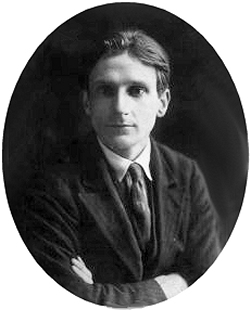
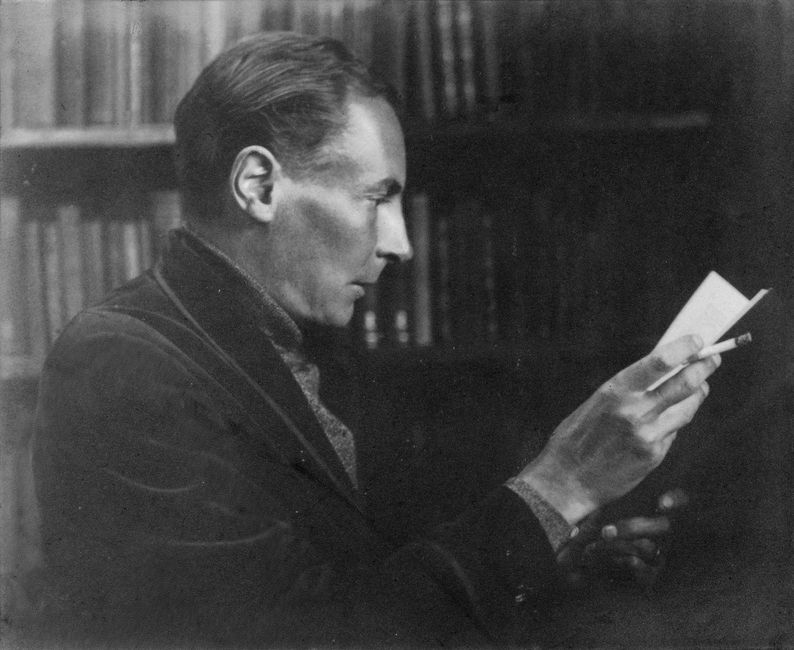
Some of these men had been writing poetry and prose before the war. The conflict provided them with an endless stream of material from which to draw. Life on the frontline, or close to it, was not all ‘going over the top’. Endless hours of waiting gave many the time they needed to write down their thoughts and edit the lines they composed for the audience at home to read.
For others, the war had always engendered a sense of foreboding - Isaac Rosenberg’s On Receiving News of the War is a chilling muse on how war is inherent blood lust - history repeating itself. The romantic idea of war was disappearing for ever, replaced by the grim reality of life in conflict.
Isaac Rosenberg volunteered and served as a Private in the British army during the war. His poems are some of the most famous and, unlike many of the other war poets, he was not an officer or from a middle class or wealthy background. Rosenberg was the son of poor Jewish immigrants and much of his artistic work was influenced by this and his feelings towards his cultural and religious identity. His work written in the trenches often portrays the squalor of trench life and his revulsion to the death happening around him.
Siegfried Sassoon is another First World War poet with a Jewish background. In his case, his father was Jewish, but his upbringing could not be further from Rosenberg’s. Sassoon was raised by his Anglican middle-class mother and saw himself as very much the country gentleman. Sassoon started the war with a very romantic idea of battle but changed tack after many of his close friends were killed. His poetry, as the war progresses, takes on a critical tone and he is famous for a letter criticising the leadership of the war, which, when published, resulted in his being sent to Craiglockhart hospital for ‘shell shock’. Sassoon continued to be critical of the war in his works published after 1918.
A century later, it is through poetry that many people first experience what the First World War was like for those in uniform. Many of the ‘trench’ poets who wrote down their thoughts and feelings have become household names whose works are taught in schools and seen as a key part of the historical record. The War Poets of the First World War are men and women whose lives were changed forever by their experiences and who have, through their words, changed attitudes to war of many generations since.
War poetry provides an access point for subsequent generations to try and understand an intense, complex event in our history, the scale of which seems incomprehensible. The poems provide windows of reality and the poet becomes the embodiment of the Tommy - the British soldier.
In truth, war poetry is only a part of the reality, often written by men and women who came from civilian life and found themselves caught up in the demands of the age. Some critics claim that war poetry distorts the reality of conflict and that, as an artistic response, it only reflects the drama. For others, the poems ensure that the brutality of war is captured for those who didn’t experience it.
In November 1985, a slate memorial was unveiled in Poet's Corner in Westminster Abbey which commemorates sixteen poets of the Great War: Richard Aldington, Laurence Binyon, Edmund Blunden, Rupert Brooke, Wilfrid Gibson, Robert Graves, Julian Grenfell, Ivor Gurney, David Jones, Robert Nichols, Wilfred Owen, Herbert Read, Isaac Rosenberg, Siegfried Sassoon, Charles Sorley and Edward Thomas.
This is not an exhaustive list of those who served and created lasting memories of that time - WN Hodgson MC in Before Action epitomises the tragedy of 1st July 1916 while the works of Vera Brittain highlight the experiences of women near the Frontline.
Many of the war poets did not return from the battlefields but their words, their very personal, emotive reflections on being caught up in the conflict, are preserved in their poetry. Their sacrifice and contribution will be remembered and their voices will continue to be heard.