• A
  • A
  • A

Jewish Communities in the UK in 1914

The Jewish community of the UK in 1914 was really a mixture of a number of Jewish communities; some integrated into British life at all levels, and others still speaking Yiddish and finding their place in British society.

There had been a small Jewish community in the UK from the 18th century; mainly of the mercantile and professional classes. This mainly Spanish and Portuguese ‘Sephardi’ Community had arrived via the Dutch community. Immigration grew quickly from the 1880s when antisemitism, and in particular policies in Russia, led many Jews of Eastern Europe to flee those areas. Between 1880 and 1905 the community grew by around 150,000.

By 1914 the Jewish community was approximately 250,000 - 300,000 in a total British population of over 41 million. Yiddish is a mixture of German dialects and Hebrew, often including Polish words or others bits of language from where the Jewish communities were settled. It was written down using Hebrew script. In 1914 many of those in the Jewish communities still spoke Yiddish as their main language and there were numerous Yiddish newspapers and entertainments available.

Life for the new(ish) immigrant was overseen by the established community in many cases. The later were concerned that the new arrivals might increase antisemitism which was common across Europe, including in the UK. Newspapers and officials would frequently generalise and be disparaging about Jewish groups and individuals.

Many Jews that settled in the UK prior to the 1880s had been keen to assimilate into British life while keeping their Jewish faith. The feeling was very much about integration though not assimilation.

The established community helped to found welfare funds and education activities to try and help the migrants to learn English and to blend more easily into British life – whether they wanted to or not.

However, it would be unrealistic to assume that the Jewish communities operated with an agreed form of hegemony. In most communities there would be more than one synagogue, for the differing religious practices or representing different political concerns. While to the non-Jewish outsider the Jews may have seemed like one group, to those within the community it was a mixture of social classes, backgrounds, languages, ideas, politics and beliefs.

Prior to 1914 Jews were serving in the Royal Navy from at least the time of Nelson and Trafalgar and undoubtedly earlier. However, all Jewish servicemen would have given up an element of religious life in order to fulfil their military duties – this is not particular to Judaism but was simply that military practices are not always consistent with a strict religious adherence.

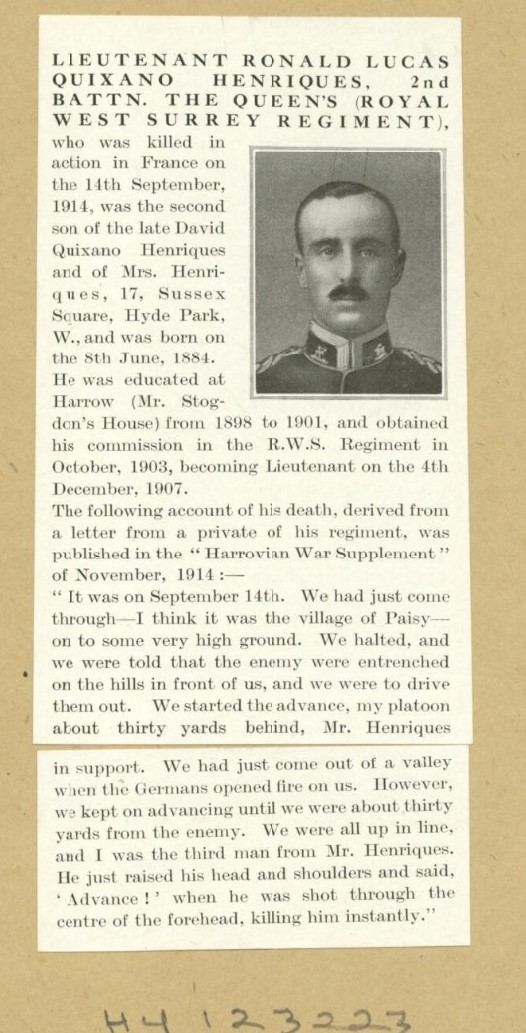
The Jews serving in the army and the navy prior to World War One, like most volunteers that became professional soldiers at that time, usually joined a regiment that had a local or regional connection. This continued into the First World War with those enlisting in 1914 and 15 largely assigned to local regiments. In London many joined the Royal Fusiliers – a London regiment. As the war progressed Jews could be assigned to whichever regiment needed men, just like any other new recruit.

Faith and religion has often been a strong component of a military regiment. The guidance and support of a spiritual source deemed to be of particular importance during times of conflict. This understanding of religious support was extended to the Jewish members of the armed forces with the appointment of a Jewish Chaplain; first appointed to the Territorial Forces in 1909. Although it was only the Territorial Forces (and there was quite some lobbying to establish it), it was recognition that there were sufficient Jewish men in the armed forces to need some form of religious representation. Even before the official appointment of the Jewish Chaplaincy, Jewish servicemen had come together for an annual Hanukkah Service.

By Paula Kitching

Give us your feedback

Please tell us what you think to help us develop and progress this vital resource

London Jews in the First World War - We Were There Too

Follow us on social media:

  • Twitter
  • Facebook
  • Instagram

© London Jewish Cultural Centre 2018

Website by Beachshore