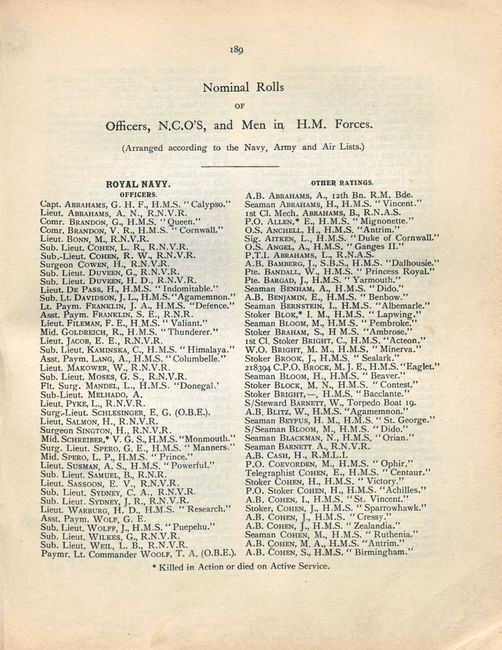
John Woolf Bandall alias Jack Woolf Cohen was one of 10 children born to Harris and Amelia Cohen who lived in in Birmingham, Warwickshire. After leaving school he worked as tailor’s presser before enlisting in the Royal Marines Light Infantry on September 1899. In his 21 year Royal Marine career he served on 17 ships and was injured in the Battle of Jutland in 1916.
Whilst serving on the HMS "Princess Royal", Woolf wrote this letter to the Chaplain, Reverend Michael Adler which was published in the Jewish Chronicle on 23 April 1915
Rev. Sir,
- "A Guten Yontiff”
I am writing to let you know that I and Stoker Simmons tried to get leave to proceed, he to London, and I to Birmingham, but without any success; for as the great Sir David (Admiral Sir David Beatty) himself (we were taken before the Admiral) pointed out to us, "It is the price we pay for the privilege of serving in the first line of defence.
This constant watching and waiting on the part of every single unit, which puts the question of leave, even to men wishing to pay the last respects to their dead or dying relatives, a thing not to be dreamt of. So instead, the first Seder night was spent (8 p.m. to midnight) around one of the guns; part of the time with an eye glued to the telescopic sights and an ear in very close proximity to an adjacent Navy phone, and the remainder of the time with my head on a projectile for a pillow, and the bare deck for my bed - asleep (?)
The Grand Fleet were moving on one of their usual scouring expeditions; by the speed they were travelling at they were out for blood; at the time I was thinking they were after clearing more chometz; but still, even on such an occasion there was hardly any reason for quoting the Hagadah, "Ma Nishtana," etc., for since war has been declared, many and many, if not all, nights have been like that. The second Seder night was more cheerful- We were in harbour, and the cinema which has lately been added was the cause of a few cheerful hours for the ship's company. One of the officers lent his gramophone, and I was rather startled whilst gazing at a film, which was of a sentimental nature, to hear grinding forth from one of the records the 'cello solo of Auguste Van Blene's "Kol Nidre."
We (I and Simmons) have received the abridged Hagadahs , and as far as I am concerned will, if the Almighty spare me, keep the soldier’s Prayer Book with the Pesachdiker one, among their Gracious Majesty's gifts, Princess Mary's gifts, such honours or medals, identification disc, swimming collar or belt, etc., as mementos of the great war, for future generations to look at and admire. In conclusion, I am pleased to state that we are in the best of health, and have plenty of little luxuries sent by sympathetic ladies and gentlemen;. Plenty of magazines, books, pipes, tobacco, cigarettes, in fact we have plenty of everything except - leave, and - but don't buzz it, for fear of the Germans getting to know, there is a minute possibility of us getting even that.
Once again, to you and Rev. Llpson and the other assistant chaplains, may you all live long to enjoy many and many a Pesach to come. . .
After leaving the Royal Marines in September 1920, Woolf worked as a steward on the ‘Orduna’ between June 1922 and October 1923 on six transatlantic roundtrips sailing between Hamburg, Southampton, Cherbourg and New York. He was discharged in New York and worked as a Butler until July 1930 when he returned to live in London. He never married and died in December 1966.
Researched for 'We Were There Too' by Dr Ronnie Fraser
Give us your feedback
Please tell us what you think to help us develop and progress this vital resource