The previous two Battles of Ypres, in 1914 and 1915, launched by the Germans, had led to a stalemate in the region. General Sir Douglas Haig, the British Commander in Chief in France had wanted to launch an attack around Ypres for some time in the belief that he could make a breakthrough there that had not been possible further down the Western Front.
The success of the Battle of Messines in May 1917, planned and executed by General Plumer, had released the southern arc of the Ypres Salient down towards Ploegsteert (Plugstreet). Haig was confident that his plans for a major offensive around Ypres would lead to a wider breakthrough across Flanders. Rumours of a Russian collapse in the East after the Russian Revolution that Spring and problems on the German lines spurred Haig forward.
The Germans held the high ground around the Northern and Eastern part of the Ypres Salient, with well dug in defences and protected positions. To destroy those defences, the British bombarded the German line for 10 days. An estimated 3,000 guns fired 4.25 million shells.
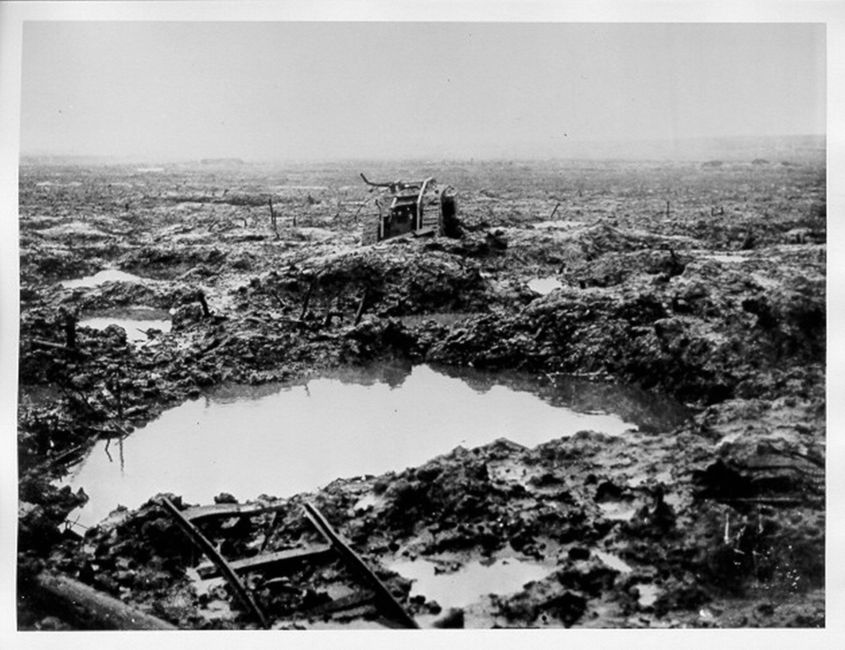
At 3.50am on 31st July, the British infantry started their attack. The German Fourth Army held off the main British advance and restricted the British to small gains on the first day, slowing down the overall attack. The whole area around Ypres and across Flanders had seen three years of continuous fighting, making the ground extremely difficult to cross. Bombardments from both sides had destroyed the drainage system and the land was covered in water-logged shell holes and mine craters. In August, after unusually heavy rainfall, the whole of the Ypres area became one large swamp. The mud made fighting extremely difficult and added another level of danger – drowning and infection. Tanks, the new technology, that were expected to make a major difference in the attack became bogged down in the mud and were either unable to move or were disabled.
As the fighting continued, the Germans introduced Mustard Gas to their arsenal. The battle became one long tortuous experience immortalised in the British collective memory by Wilfred Owen’s poem ‘Dulce et decorum est’.
The village and ridge of Passchendaele were finally taken in early November, but the cost of the whole battle had been huge, with many critical of Haig’s decision to keep fighting as the casualties mounted. The result around Ypres was that although the salient had been widened by several kilometres, no main breakthrough had been achieved. The Allies suffered an estimated 310,000 casualties, 300,000 of them from the British Expeditionary Force. This compared to German casualties of 260,000. The numerous cemeteries in the area, including Tyne Cot, the largest Commonwealth War Graves Commission cemetery in the world, provide the real legacy of the battle.