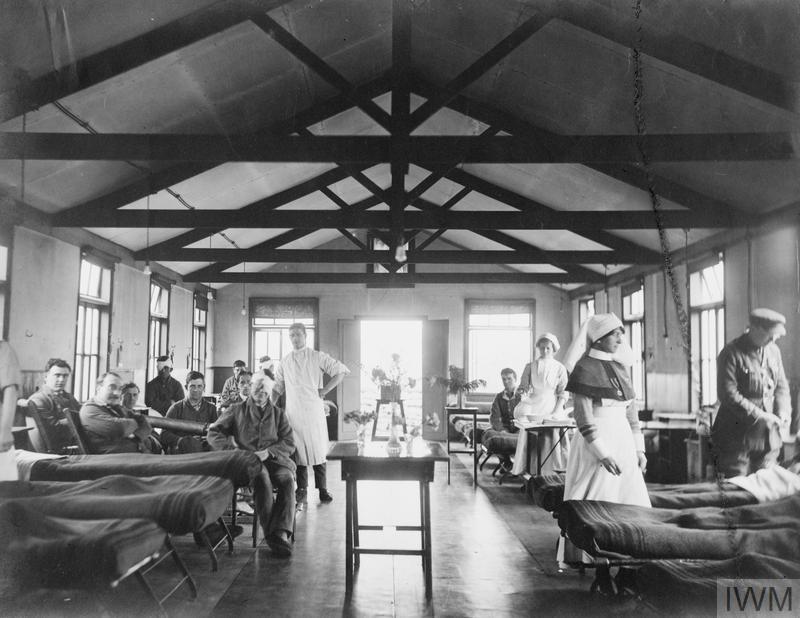


A member of the QAIMNS, a young woman called Nellie Spindler.
Nellie was born in Wakefield, in 1891, into an ordinary family. Her father was a policeman who had risen to the rank of inspector before the war. She decided upon a career in nursing and trained at the Township Infirmary, Leeds from 1912-1915. After her training, she responded to the growing call of people to volunteer for the war effort and joined the QAIMNS Reserves. She served as a Staff Nurse at Whittington Military Hospital, Litchfield, from November 1915 until May 1917.
In May 1917 she was sent to a Casualty Clearing Station in Flanders. A Casualty Clearing Station (CCS) was a mobile medical station close to the front line. It was there that casualties were removed to straight from the battlefield to be given whatever medical attention was available. Depending on the size and permanency of the site, this could be anything from a rudimentary treatment to full surgical operations. A CCS could be forced to pack up and move with little notice if it came under fire, or needed to be in a better location. Usually the CCS would be made of tents and makeshift buildings.
As time went on and some of the battlefronts became more permanent some CCSs had more permanent structures and formed part of a more complex medical system of care and treatment before the sick and injured were evacuated further back behind the line. Many CCSs were marked not just by the Red Crosses on their tents but by the small burial ground that was inevitably created next to them. For the modern day visitor to the battlefields of the Western Front, many of the Commonwealth War Graves Commission (CWGC) cemeteries that now exist are there as a result of being on the site of a former CCS.
The staff of a CCS included a mixture of medical (surgical) male doctors from the RAMC, nurses – female and orderlies, or VADs. Some lived close to the site, billeted in tents whilst others might be put up in the nearest town of village and be expected to travel to their shift each day.
The CCSs were often very close to the front line and, officially, this was one of the closest places to the front a women could be stationed.
A number of CCS existed on the approach to the town of Ypres, Belgium, a site of some of the fiercest fighting of the whole of the First World War. It was in one of these (now the site of Brandhoek CWGC cemetery) that Nellie went to serve in May 1917. She was there as the third Battle of Ypres (Passchendaele) began in July 1917, treating the large number of casualties that the battle created. However, the CCS that she was at was close to the railway supply lines and became a target for a German bombardment. On 24 August 1917, the CCS was hit by enemy fire and a number of nurses were injured, including Nellie. After about 20 minutes she died of her injuries. The CCS was packed up and all members evacuated to the site of Lijssenthoek CCS hospital and now CWGC cemetery. With no time to bury the dead Nellie’s body along with the other casualties was taken with them.
Nellie was buried at Lijssenthoek with a full military funeral, including the Last Post played over her grave. Just like every other confirmed death in the conflict her family were informed by telegram from the War Office that she was ‘Killed in Action’. She had an obituary in her local paper and in the British Journal of Nursing. Nellie was 26 when she was killed.
Today her grave is part one of 10,755 graves at Lijssenhoek CWGC cemetery, the only woman to be buried there. Although very few nurses were actually killed in action so close to the front (she is only one of two buried in Belgium), it doesn’t take away from the very real danger that they faced in their role as a nurse serving overseas in the First World War.
Back home in England, Nellie’s death was a very clear reminder of how the war was an all encompassing beast. At her memorial service hundreds paid their respect, even though they did not know her. She was a reminder that war was now the business of men and women.
References:
A nurse at the Front, by Ruth Cowan, Simon & Shuster, London 2012
The British Journal of Nursing 1917
http://www.wakefieldfhs.org.uk/Nelly%20Spindler.htm