Basic Information
Birth
Death
Place of death:
Eastbourne
Places
Addresses
253 York Street Cheetham Manchester (1891)
Parents' home:
257 Cheetham Hill Road Manchester (1901)
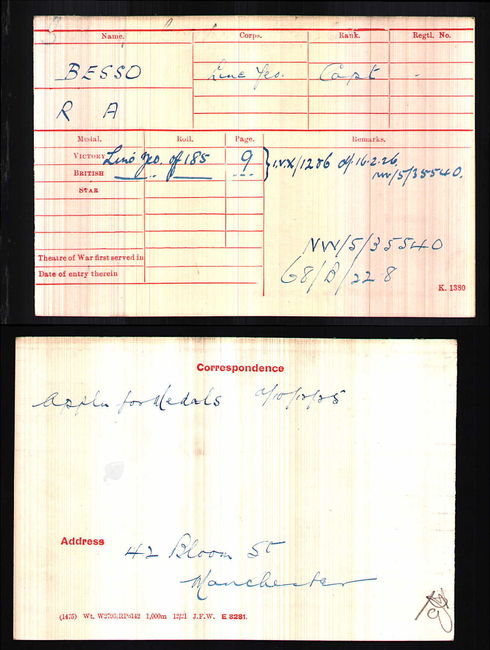
42 Bloom Street Manchester (1922)
Schools
Commission into Lincolnshire Yeomanry 1915
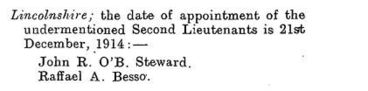
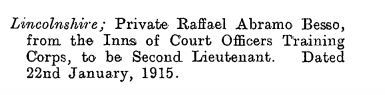
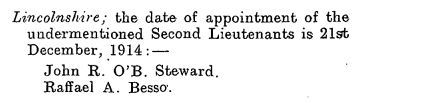
Entering the prestigious Inns of Court Officers Training Corps on 2nd October 1914, Besso undertook basic training. He was commissioned as a Second Lieutenant and posted as a cavalry officer to the 1/1st Battalion, Lincolnshire Yeomanry (part of North Midland Mounted Brigade, 1st Mounted Division) in Norfolk on 22nd January the following year. On 27th October 1915 the brigade embarked at Southampton for Salonika, but was diverted en route to Egypt, landing at Cairo in November.
War in the Desert 1916
From Egypt, the Lincolnshire Yeomanry was designated as part of 22nd Mounted Brigade and, from April 1916, formed part of the Western Frontier Force, which was formed in response to the Axis-backed uprising by Senussi tribesmen from Libya.
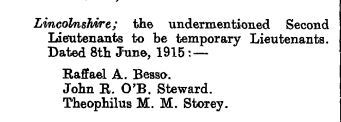
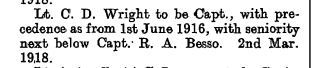
Besso himself was promoted to Lieutenant on 1st June 1916 and was heavily involved in readying himself and his men for the threat still posed by Senussi forces, in spite of the heavy defeat allied forces led by Major General A. Wallace CB had inflicted after the Battle of Agagia and relief of Sidi Barrani. A sustained advance pushed Senussi back over 150 miles and, while operations continued against until the end of the war the threat had largely been neutralised.
War in Palestine and promotion to Captain 1917
The change in situation led to a transfer for Besso and the Lincolnshire Yeomanry across Egypt to the Sani and Palestine front in February 1917 as part of the Australian and New Zealand (ANZAC) Mounted Division under New Zealand officer, Major General Sir Edward Chaytor KCMG KCVO CB. Participating in the second Battle of Gaza (17th – 19th April) Besso was engaged in the heaviest fighting of his war to date. Subject to aerial and artillery bombardments in the build up to the offensive the 22nd Mounted Brigade were also attached by Ottoman Cavalry, causing the loss of some outposts, with shelling causing further casualties. Despite losses the threat of an Ottoman infantry assault on the evening of 19th April did not materialise and much of the position was held. The assault led ultimately to defeat, with 105 casualties of a total of almost 6,000 being incurred by Besso’s ANZAC Division (the lightest of the six formations involved).
As part of general reorganisations following the battle the Lincolnshire Yeomanry, along with other mounted units from the Egyptian Expeditionary Force, were transferred back to British command as part of the newly formed Yeomanry Mounted Division, which was raised at Khan Yunis in Palestine during June and July 1917. Operating once again in the desert Besso and his troops were engaged in the successful third Battle of Gaza, the capture of Beersheba and the Sheria Position during late October and early November, a month which would see the Lincolnshire Yeomanry involved in further heavy fighting. El Maghar (13th – 14th November), the Battle of Nabi Samweil (17th – 24th November) and the Turkish defence of Jeursalem (27th - 29th November) all saw Ottoman forces in the Eastern Desert systematically pushed back with the Yeomanry Mounted Division forming an integral part of the campaign.
Besso clearly distinguished himself during the operations and, on 18th February 1918 was promoted to Captain.
War in France 1918
Further changes to formation in April 1918 saw this division being redesegnated initially as 1st Mounted Division, restructuring which heralded the end of Besso’s desert war and a transformation in his war service. On 7th April the Lincolnshire Yeomanry left both the brigade and their horses, dismounting and being reconfigured, along with 1/1st Battalion, the East Riding Yeomanry, as D Battalion, the Machine Gun Corps.
After training and reorganisation the newly promoted Captain Besso and the battalion, once more redesignated as 102nd and attached to Sir Henry Horne’s First Army, arrived in France in August 1918. By this time the German Spring Offensive of Spring had been held and allied forces were pushing back. The ‘Hundred Day Offensive’, launched on 8th August, saw the German forces defeated on the Somme, Hindenburg Line and beyond. Though casualties remained high the operation was successful and contributed to the Armistice of 11th November 1918.
Discharge 1921
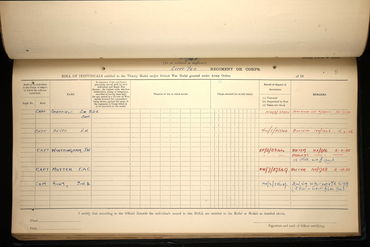
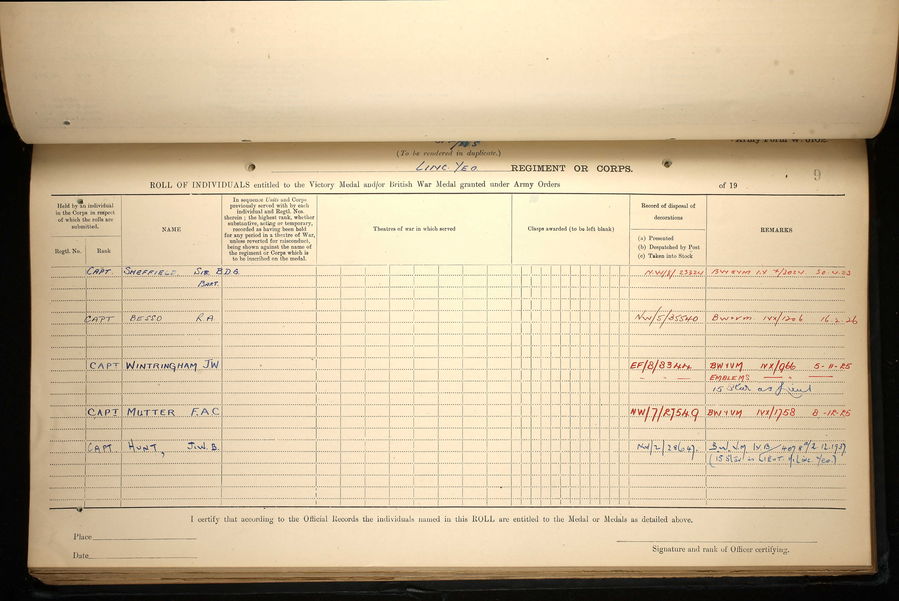
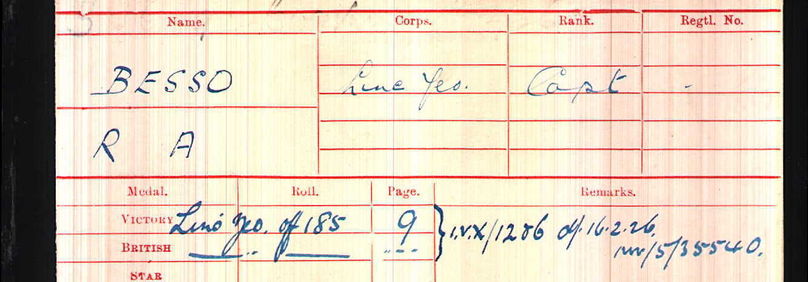
By the end of the war Besso, who had volunteered from his home in Manchester, served in Egypt and both the Eastern and Western Desert as a cavalry officer was the 37 year old commander of a Machine Gun company in the mud of the Western Front. His had been a war of broad experiences. After a period of reorganisation he resigned his commission on 31st September 1921, receiving his British War and Victory medals for his service on 10th December 1925.
All stories courtesy of https://livesofthefirstworldwar.iwm.org.uk/lifestory/321691