My grandmother, Rachael, was born in Odessa in 1895; the only daughter of Samuel and Golda Wisotzki who were married in 1893. Samuel3, ran a commodities business from Odessa in partnership with his brother, George, who immigrated to Palestine at about the same time as Samuel brought his family to London. George Wisotzki founded the eponymous tea company that survives in Israel today.
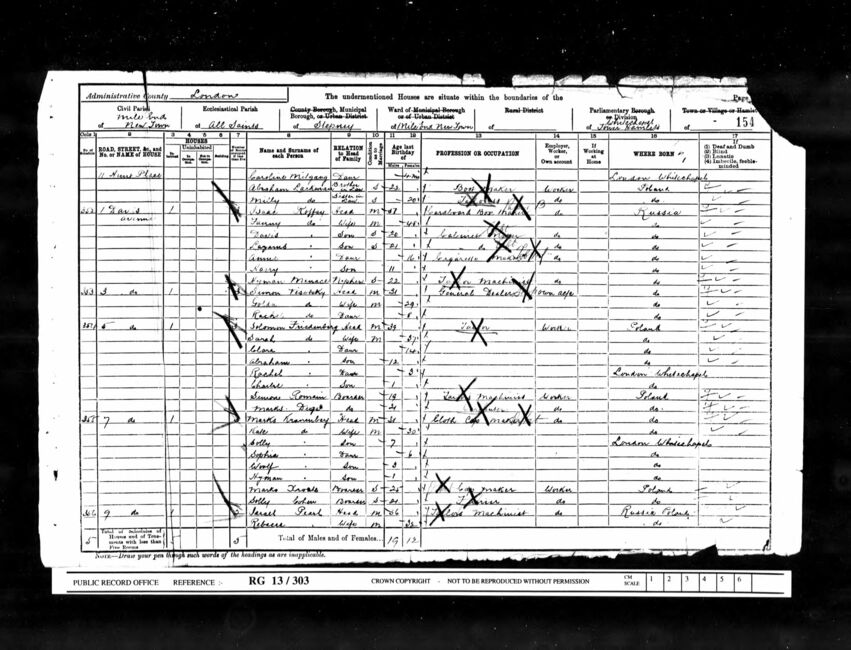
Samuel’s family arrived in Stepney around 1900 and by 1914 they were living in Arbour Square, Bow, which was then a relatively up-market part of London’s sprawling East End. Samuel had established himself as a comfortably-off flour merchant, or miller. In those days there were many windmills for flour-grinding in the East End. Although I have not been able to find evidence for this, Rachael told me that Rank Hovis McDougall had its origins in her father’s business. She also described travelling in her father’s horse-drawn coach.
Unusually for a girl from immigrant stock, Rachael was educated to a reasonably high level. She would have attended an elementary school. And, her father later employed a private teacher for her called Mr Blumenthal, a fellow-refugee, who had lived in the USA before coming to London as a long-term lodger with the Wisotzki family. Rachael became fluent in English and Yiddish; she spoke some German, and with Mr Blumenthal’s tutelage, she became proficient in arithmetic and bookkeeping.
I have not been able to learn much about Mr Blumenthal’s background or circumstances, but infer that, like the Wisotzkis he was a devout orthodox Jew. My Aunt Sheila1 (Rachel’s daughter) avers that Blumenthal worked for a bank, the Jewish Colonial Trust, which could be the reason for his transfer to London from USA.
Samuel was naturalised and obtained a British passport for travel to Europe in 1912. His naturalisation papers were signed personally by the then Home Secretary, Winston Churchill, and the Foreign Secretary, Earl Grey2
We do not know why, or to what part of Europe he visited; but, on returning to London, Samuel Wisotzki contracted polio, for which there was no cure in the early 20th century. He probably caught the disease during his travels; his health deteriorated and he became addicted to morphine, the then recognised medical treatment. His business was lost and the family suffered many years of hardship.
He eventually died on 12 December 1921, in his mid-fifties.
Rachael, known in our family as Booba, went out to work to support the family and pay for her father’s medication. She was first employed at the Jewish Colonial Trust (now Bank Leumi), where she would have been introduced by Mr Blumenthal. However, after the outbreak of war with Germany in 1914, she was working at a local Post Office. All post office clerks would have been male until then, but women were rapidly replacing the men, who either were volunteering, or being conscripted into the forces.
Booba’s financial experience and bookkeeping abilities were put to good effect in the Post Office; although she had a more important role: There were large numbers of Jewish soldiers and sailors away from home. Many of their fathers or uncles had been forcibly conscripted into the Russian army in the 19th century; their first- generation English sons felt honoured to serve in the British forces. The majority of these Jewish servicemen came from London’s East End and were proud of the opportunity of fighting for their adopted country; a democracy that offered so much for their future.
It was a long war and the soldiers or sailors would write home frequently. The problem was that British officers had to read all letters home for security and possible censoring. All men were, therefore, required to write their letters home in English. What’s the problem? Their parents back in London often could not read. Those who could read, frequently did not understand enough English.
In the early 20th century there were three or more postal deliveries every weekday. Parents of frontline troops would arrive at any time of the day; queue in front of Booba’s grille at the post office-counter with letters in their hands. Although very busy selling stamps, taking telegrams, paying out allowances (old age pensions had recently been introduced), and a host of other clerical duties, Booba would translate the letters into Yiddish, aloud through the grille, to anxious relatives. For those parents who were able to read, she wrote in Yiddish between the lines of English, so that they could share their letters with other relatives.
After the war, Rachael married my grandfather, David Cohen. In his mid-twenties, and a refugee from Lodz, Poland, he was an orthodox Jew who arrived in the UK just before WW1 on a coal-ship, landing at Pembroke Dock in Milford Haven. There was a Jewish community in South Wales, established by earlier immigrants from Eastern Europe one of whom was David’s uncle. David found accommodation within the community and he acquired a bicycle. He worked as a peddler, selling haberdashery and small household goods to the rural population of villages, farms and hamlets in the Pembroke Dock and Swansea region. It was a difficult existence, but preferable to the abject poverty and religious persecution in Poland.
David worked hard; his business thrived by giving a reliable service and good value to regular customers, one of whom was the wife of a local Mayor. Through this contact, David heard about a military hospital, where German prisoners-of-war were being treated. The patients spoke no English and David was told that a group of them had inexplicably started refusing food. The Mayor accepted his offer of help; David visited the hospital and was able to speak to the soldiers in Yiddish. It was Passover and he identified them as Jews. He used his own contacts from the small South Wales Jewish community, to arrange a supply of matzos and other Passover-food to be sent from London. Problem solved!
Rachael and David were introduced and they married in 1920. David, who was a heavy smoker, died from lung cancer in 1953. He was a founder-member of the Adath Yisroel synagogue in Hendon. Rachael lived a long, eventful life until her death in 1980. She and David had 2 daughters, Diana (my mother) and Sheila, and 5 grandchildren. In later life Rachael would travel far and wide.
Philip Tobin




Give us your feedback
Please tell us what you think to help us develop and progress this vital resource