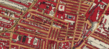
These immigrant Jews found work in the factories which were keen to recruit unskilled labour. They were “aliens in religion, language and often dress” which accentuated their differences to the local population.[4] The immigrants wanted to live close to each other, making it easier to speak Yiddish, their own language, have Kosher shops and be close to synagogues where they not only prayed, but was also the centre of their social life. Most of these new Leeds immigrants were living in the Leyland district, an area of poor housing which was also very close to the town centre. Their isolation from the rest of the Leeds population had already caused bad feeling and problems. The Jewish Chronicle referred to a “so-called feud between Christian and Jewish youths in certain quarters of the town”[5] and the Nottinghamshire Guardian is also quoted as saying “Leeds has for some years past attracted large number of foreign Jews, until the Ghetto of the West Riding capital has assumed extraordinary proportions” and that “recently, a series of racial feuds have arisen between English and Jewish boys in Leeds and active trouble has developed.”[6]
Leeds Anti-Jewish Riots, June 1917
By Lola Fraser
The night of the 3rd-4th June 1917 saw anti-Jewish rioting in Leeds. Jewish businesses were targeted in the Leyland district, shops were vandalised and looted and Jewish people were attacked and injured It was not until the 5th June that peace once again came to the Jewish area as the police turned up in sufficient numbers to frighten off the rioters. So why did these events happen?
Jews had been allowed to settle in England from 1656 with people arriving here from various places. Initially it was traders, primarily Sephardi Jews whose families had fled Spain in the 14th century and Portugal from 1536, and whose ships traded between the West Indies and Amsterdam. These Jews were followed by Ashkenazi Jews from Holland and also Germany in the 17th and 18th centuries.
Leeds jewish Community
Leeds grew from being just a small market town into a centre for cloth-finishing, which had been introduced by Flemish weavers in the 14th century. By the mid-19th century Jews were coming to Britain from not just Holland and Germany but also from Poland, although it was just a trickle at first, the Jews from Poland and then Russia soon became, by the end of the century, a flood, drawn to the area to find work in tailoring, an industry they knew.[1]
The Leeds Jewish Community, it is usually agreed, was established in 1840.[2] The first synagogue was opened in 1846 and so the community grew. By the 1880s, Leeds, whilst being the centre of the woollen manufacturing trade, was also an industrial hub, with railway links from Hull through Leeds and Manchester to Liverpool. This also made it a magnet for Jewish immigrants who had begun leaving Russia for several reasons, including poor harvest leading to food shortages, anti-Jewish pogroms and the fact that the boys were to be conscripted into the Russian army from the age of 10 or 12 never to see their parents or homes again.[3] Between 1880 and 1914 it is estimated that between 120,000 and 150,000 Eastern European Jews settled in Britain, overwhelming the 60,000 established Jewish community of Britain.
-
 Jewish Immigrant Settlement Patterns in Manchester and Leeds 1881 (Scientific Figure on ResearchGate)
 -
 Leylands District (Ordnance Survey/National Library of Scotland)
-
Jewish Immigrant Settlement Patterns in Manchester and Leeds 1881 (Scientific Figure on ResearchGate)Image ID20715
-
Leylands District (Ordnance Survey/National Library of Scotland)Image ID20714
-
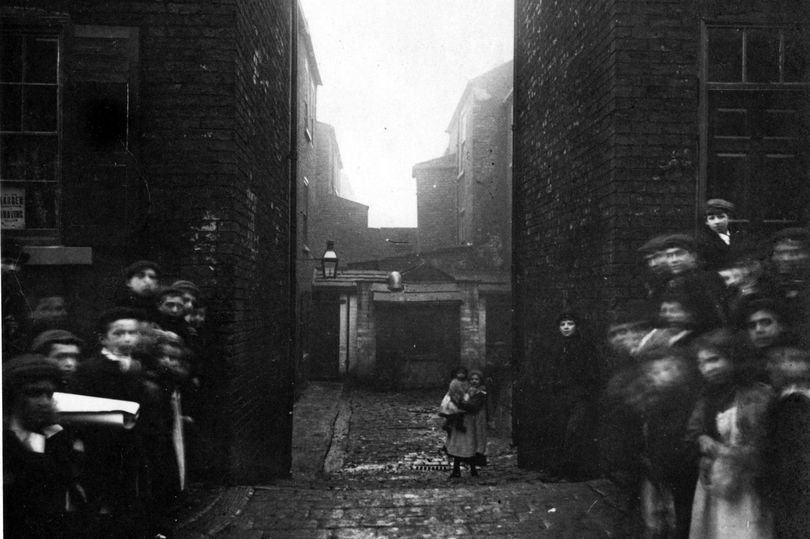 Bridge Court, 1901 (Leodis.net by Leeds Libraries)
 -
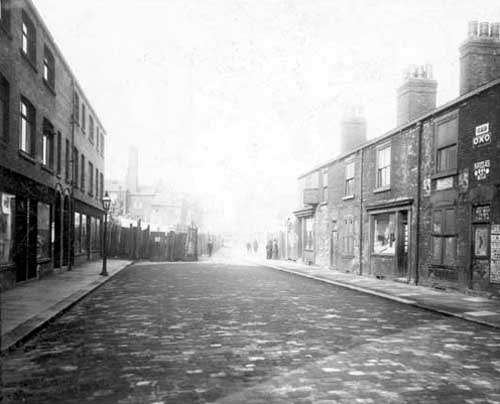 Bridge Street, 1909 (Leodis.net by Leeds Libraries)
 -
 Noble Street and Hope Street c.1900 (Leodis.net by Leeds Libraries)
 -
 Back Nile Street Synagogue, 1908 (Leodis.net by Leeds Libraries)
-
Bridge Court, 1901 (Leodis.net by Leeds Libraries)Situated off Bridge Street, between Nile Street and Trafalgar Street, area of dense housing. An open gutter can be seen in the yard illustrating the insanitary conditions which led to this area being classed as 'unhealthy'.Image ID20713
-
Bridge Street, 1909 (Leodis.net by Leeds Libraries)Taken prior to the Hope Street improvements looking north up Bridge Street, showing retail premises in this predominantly Jewish quarter. Shops visible are: Morris Hyman, tailors trimmings: Max Philips, confectioner: Ralph Levi, bookseller. The premises on the right are two-storey terraced brick built. Premises on the left are 3-storey terraced brick built. At the far end of the street Hope Street is visible with apparent improvement works being carried out. There are various advertisement posters on the shops such as OXO, Nestle's Milk, Butterfly cigarettes and Rowntree's chocolates. There is also a poster written in Hebrew.Image ID20717
-
Noble Street and Hope Street c.1900 (Leodis.net by Leeds Libraries)Levi and Co kosher wine and spirit merchant can be seen to the leftImage ID20718
-
Back Nile Street Synagogue, 1908 (Leodis.net by Leeds Libraries)Image ID20716


Many of these immigrants were members of trade unions, in which there was a considerable body of political opposition to the war,[7] along with that was the added complication of the immigrants’ ability to join the army.
Military Service and Leeds Jewish immigrants
The perception in 1917 was that Russian Jewish immigrants were ‘shirking their duty’ and not signing up to serve. The situation was, however, more complicated. In 1914 in order to sign up, a man would need to be British or return to the friendly country from which he had come. Some Jewish immigrants had taken Naturalisation, the cost of which in 1913 was £3,[8] bearing in mind that the wage for a skilled worker in the North East of England was 30 shillings (£1.50) a week,[9] whilst many of these immigrant workers were not skilled, the cost was prohibitive for many people. Some men did return to Russia to serve, some returned after the war, some did not. In Leeds, one out of five Jewish military recruits in the First World War were rejected – three times the rate for non-Jews – the chief reasons being lung disease and myopia.[10]
It was in this light that we can see that the immigrant Jews of Leeds who, even if they wanted to join the British army, were having difficulties in doing so. Many of them, not being naturalised British citizens, found it difficult or impossible to sign up. Some refused, and those who were still Russian citizens were expected to return home (see ‘Russia or Britain -take your pick!’ History Window).
It was unsurprising that whilst many immigrant men managed to sign up, especially after conscription was introduced in January 1916, some still refused to fight, and so “in the spring of 1917, the (British) government concluded an agreement with the Russian authorities under which Russian-born Jews would either be conscripted into the British forces or returned to Russia to serve there.” [11] The Government acted, so that between 1914 and 1918, 20,000 aliens were deported and 32,000 were interned. Most were males; some were married; many were Jews.[12]
The Labour and Socialist Convention, 3rd June 1917
It can be no coincidence that the 3rd June 1917 saw the first meeting, in Leeds, of the Labour and Socialist Convention held expressly “to follow Russia”. Many of the immigrant Jews of Leeds were not only members of the trade unions, some were even communists, socialists or Bolsheviks. So that together all these factors fed into the bad feeling which saw a simple fight by children, escalate into something much more serious.
The Convention was set up to support the new Socialist Government of Russia and to encourage the British Government to support pacifist socialist ideals, as well as supporting peace and a cessation of hostilities with Germany and its allies. The speakers at the convention were all left-wing socialists, most of whom were Labour Members of Parliament.
Initially the meeting was to have taken place at the Albert Hall in Leeds, and the local hotels were initially flooded with bookings. It is estimated that by the day of the meeting, 3 June 1917, there were 3500 people in town for the convention. The owners of the Albert Hall cancelled the booking almost at the last minute, but an alternative venue was organised and the convention took place at The Coliseum. At that point many of the hotels cancelled the bookings and delegates were left to find accommodation, helped by the Socialists of Bradford who provided “improvised dormitories at the great hall of the Engineers’ Club.”
-
 The Coliseum, Leeds, now the O2 Academy (Jacqueline Banerjee for Victorian Web)
-
The Coliseum, Leeds, now the O2 Academy (Jacqueline Banerjee for Victorian Web)Image ID20712

There was also to have been an Open Air meeting after the convention on the evening of the 3rd June, but the Home Secretary sent a telegram to the Lord Mayor and the Chief Constable refusing permission for the meeting, which was rearranged to be held within the Coliseum. A large crown ‘of some thousands’[13] tried to force their way into The Coliseum but were held back by the police. Whether this crowd were pro or anti Russian is not clear, but these demonstrators were then roaming around town, and we can assume found outlet for their pro or anti-Russian feelings in the Leylands district, just half a mile, a ten minute walk, from The Coliseum.
The Jews could be seen as either being pro-Russian and therefore in sympathy with the aims of the conference, or anti-Russian as they had left Russia because of the reasons given above and against the conference. The rioters could blame the Jews on both counts, and would be seen as targets whichever side of the argument the rioters took.
The Leeds Riots 3rd- 4th June 1917
The problems began in the evening of the 3rd June in the neighbourhood of Bridge Street and Regent Street, with children playing on a disused building site and throwing sticks and bricks at one another. This soon escalated, as The Leeds Mercury reported the next day “gangs of youths, whose ages ranged from fourteen to seventeen, smashed almost all the windows of the Jewish traders in the vicinity, dragged out the contents of the windows and scattered them about the streets.” It went on to say “The residents in the neighbourhood were in a terrified condition and ... were huddled together in doorways afraid to go to bed.” One woman, they said, had been attacked, even though her husband and two brothers were serving in the army. The riot moved on to York Road near Burmantofts Street where a drapers shop belonging to a man called Samuels had the glass windows smashed.
The following day 4th June the Yorkshire Evening Post, under the headline “Riotous Street Scenes in Leeds”, reported that there were still arguments going on between “two voluble sets of womenfolk” about what caused the riots, and that there was still “considerable feeling displayed throughout the day and one gathered that many among the Jewish people in the districts affected are very revengeful for the happenings of Sunday night”. The Jewish community did not retaliate. The most serious of the incidents was “that of a Jewish soldier named Mark Rosenbloom who was home on leave, and who, in taking the part of his co-religionists, was struck on the head with a stone.” [14] According to a report in the Jewish Chronicle he had gone to the aid of a woman “who was being attacked by the mob” which was when he had his head “split open”, and although he managed to “hand his assailant over to the police, they refused either to arrest him or take his name”.[15]
The police did eventually come out to a group of “men and lads – and a score or so of undisciplined women” not to the site of the original disturbance, but to a crowd about a quarter of a mile away by the York Road viaduct, where they rushed through an archway and “every window on both sides of the streets was smashed and some of the shops plundered.” Seeing the police, the mob disappeared but it was “the evident intention [to] wreck the Jewish factories and workrooms in Templar Street.”
There were smaller incidents the following evening, although by that time the police were on duty and disbursed the crowd, although not until they had broken a few windows and frightened the Jewish community.
Rumours spread that the cause was that a group of Jewish Leeds “lads” had attacked wounded soldiers, but according to the Yorkshire Evening News who reportedly saw the incident, this was just a group of curious people crowding around the man.
By the following day, 5th June, the Chief Constable reviewed the events. He reported that on the 3rd June more than 1000 youths, men and women had been involved. “Every shop in the lower part of Bridge Street” was damaged, but only those owned by Jews, those occupied by non-Jews were not touched. On the 4th June, 3000 people were reportedly involved”. The riots had lessened by the 5th/6th and it was all over by the 18th.
-
 Leeds Mercury 4th July 1917
 -
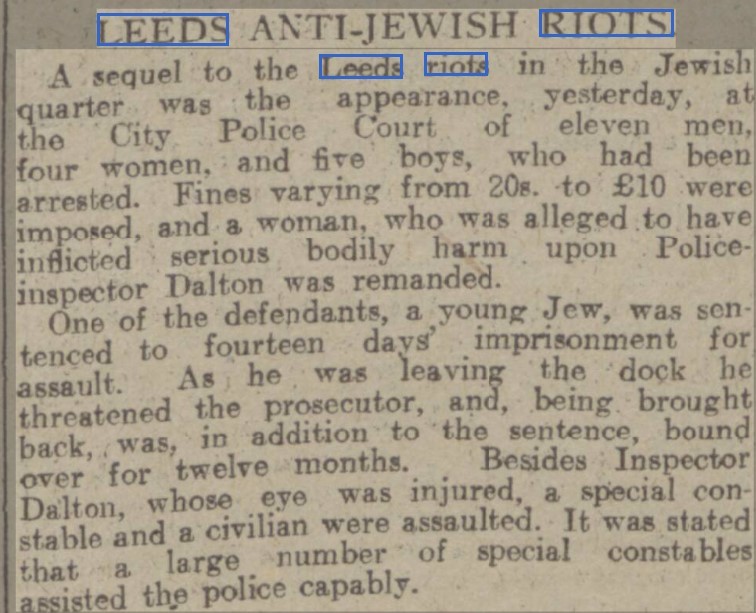 Sheffield Daily Telegraph - Wednesday 06 June 1917 (British Newspaper Archive)
-
Leeds Mercury 4th July 1917Image ID20711
-
Sheffield Daily Telegraph - Wednesday 06 June 1917 (British Newspaper Archive)Image ID20719

Press Reporting
Two weeks later, The Jewish Chronicle gave an in-depth analysis of why the riots took place. Their conclusion was that the riots were a consequence of the “very large and sudden increase in the Jewish population of Leeds” over a short period of time, meaning that “some Jews [came] into prominent notice with qualities and characteristics that have not been sympathetic.”[16] That would appear to put all the blame on the Jews, but we should also consider the very controversial Labour and Socialist Convention which was advocating a cessation of hostilities and support for the Russian stance which had turned its back on the war. This must have stirred up strong feelings towards those who were perceived as being ‘slackers’ or refusing to serve in the armed forces. There was also the almost total lack of police presence on the first night, the 3rd June, as the Leeds police were trying to manage the crowds outside the Coliseum half a mile away, with communications not what they are in the 21st century, it is easy to see why they would not have been able to manage a riot as well; so that together it became a perfect mix for the trouble which ensued.
Questions in the House of Commons
On the 28th June the Home Secretary, Sir George Cave was asked whether a report into the riots would be published, saying who was mainly responsible and also into the conduct of the police. The Home Secretary refused, saying he “did not think it necessary to publish the Reports or to make any statement on the subject” as the disturbances were promptly suppressed by the police and the Chief Constable did not anticipate any further trouble.[17]
The Leeds riots then pass into history with very little else being written or said about them. There is no doubt that to those who witnessed these frightening events they must have stayed with them for a lifetime.
[1] https://www.britannica.com/place/Leeds-England
[2] Leeds And the Jewish Community - Leeds in the age of Great Cities, by Nigel Grizzard p28
[3] Jewish Chronicle 22 April, 1870
[4] The New Community, Three Centuries of Anglo-Jewry History. by Israel Finestein p112
[5] Jewish Chronicle 8th June 1917, p14
[6] Jewish Chronicle 15th June 1917, p12 quoting Notts Guardian
[7] http://www.unionhistory.info/timeline/1914_1918.php
[9] https://api.parliament.uk/historic-hansard/written-answers/1919/aug/01/wages-1914-and-1919
[10] The Jews of Britain 1656-2000,by Todd Endelman p136
[11] https://www.longlongtrail.co.uk/soldiers/a-soldiers-life-1914-1918/enlisting-into-the-army/
[12] Policing the Ghetto: Jewish East London, 1880-1920 - David Englander - Point 32
[13] https://www.marxists.org/history/international/social-democracy/1917/leeds-guardian.htm
[14] Yorkshire Evening Post, 4 June 1917, Riotous Street Scenes in Leeds
[15] The Jewish Chronicle 8 June 1917, p14 Leeds Editorial
[16] The Jewish Chronicle, Communal Armchair by Mentor, 22 June 1917 p5
[17] Hansard, Vol 95: Disturbances in Leeds. Debated on Thursday 28 June 1917
Related Profiles


Follow us on social media:


© London Jewish Cultural Centre 2018
Documenting & commemorating the contribution British Jews made during the First World War.