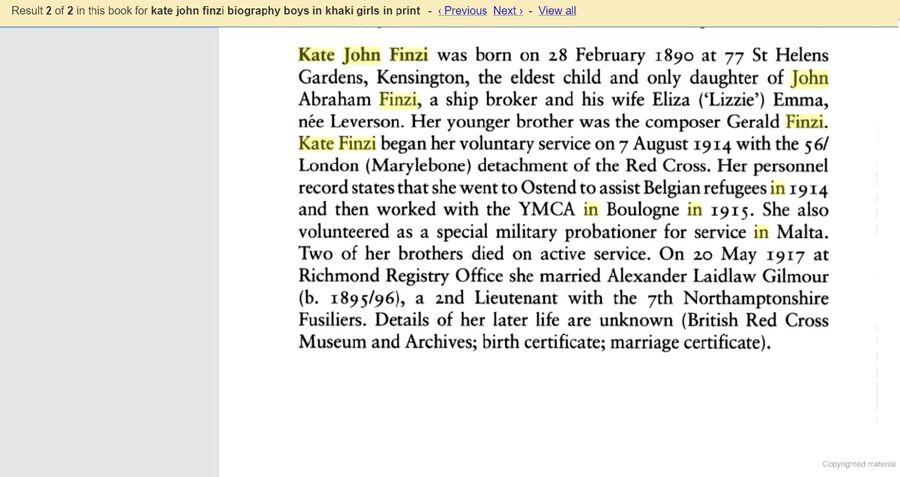
Kate John Finzi was from a Sephardi Jewish family. Kate was the eldest of five children, she had three brothers, Felix John, Douglas Louis, Edgar Cecil and Gerald Raphael. The family lived in North Kensington and her father was a Shipbroker’s agent, unfortunately, he died in 1909 and the family moved up to Yorkshire sometime after the 1911 census. Felix who was 4 years younger than Kate, went to India in 1913 and at some point, he died, but I have been unable to find out where or when. Then there was Douglas, at school in the 1911 census he passed away in 1912. Edgar the next sibling served in the RAF and was killed in 1918 he is memorialized on the boards at both Bevis Marks and Lauderdale Road synagogues, and finally Gerald the youngest went up to Yorkshire with his mother, studied music and became a composer, of some repute.
Kate’s memoir has her signing up with the British Red Cross although she explains that she was fresh from the salutary discipline of the wards of a London hospital. Then she was sent to Belgium and given the post of a ‘dresser’. She kept a diary which she later published as a memoir with the title of 18 months in the War Zone. The story begins right at the start of the war on 7th August 1914 and although it is a very interesting and easy to read book.
The book only covers the first 18 months of the war, so in late 1914 she talks in great detail, and I quote, 'of the confusion that arises out of the fact that both qualified nurses and members of the Voluntary Aid Detachment are wearing the same uniform; we heard, too,' She says of the difficulties experienced by the authorities to prevent unlicensed people organizing hospitals which they are unfitted to run.
Then the :
'function of the Censor. All letters have to be left open, posted in the military box, and, if they are to pass the Censor, must contain no mention or description of places, troops, ships, people we have met on our journey, etc.
This is not merely a precaution against spies, we are told, but a measure of prudence in regard to false rumours; for men who have never got farther than Boulogne, and never been within gunshot, have been known to write home long tirades about the bloody trenches in which they stand all day, dodging fragments of shells and killing Germans by the score! .
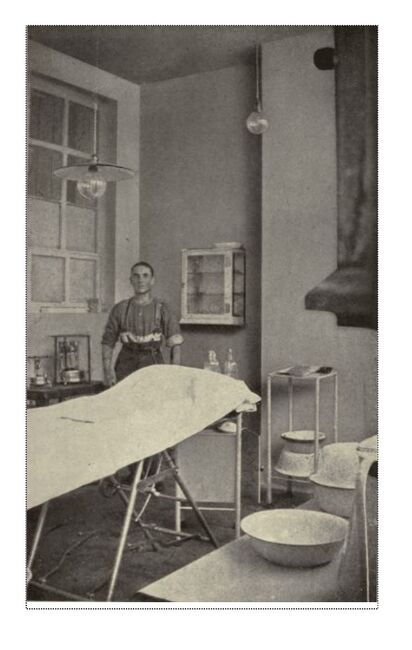
By the end of November 1914 she says things are more orderly and that she is asked to take over the military baths.
She has six orderlies to do the rough work—the washing of towels, the cleaning of the twenty baths, About 100 men come through each day
Eventually, exhausted she returned home to England in February 1916 and her story ends. She married Alexander Laidlaw Gilmour of the 7th Northamptonshire Fusiliers on 20 May 1917
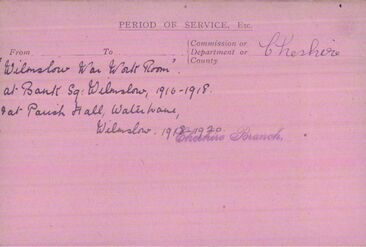
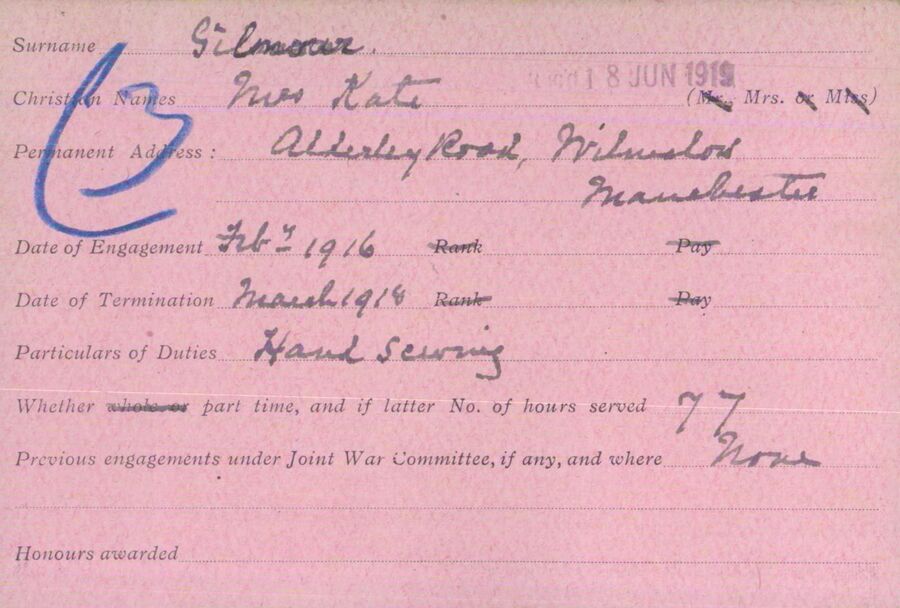
Her Red Cross card is interesting: It states that she joined in February 1916, the card is in her married name, but the surname Gilmour is written over an earlier name, presumably Finzi.
Research by Lola Fraser









Give us your feedback
Please tell us what you think to help us develop and progress this vital resource