Basic Information
Birth
Date of birth:
11 Tishri 5636 (10 October 1875)
Place of birth:
Manchester
Death
Date of death:
30 Nisan 5721 (16 April 1961)
Place of death:
Kirkcudbright
Places
Addresses
Rented house in Kirkcudbright from E.A. Hornel:
14 High Street Kirkcudbright, Dumfriesshire (1908)
Purchased house in 1938:
Woodlea, Burnside Loaning Kirkcudbright, Dumfriesshire
Schools
Name:
Manchester School of Art
Other Organisations
Name:
Manchester Academy of Fine Arts
Significance:
First picture exhibited
Name:
Royal Academy, London
Significance:
Exhibited Picture
Name:
Volunteer Battalion of the Manchester Regiment of Mounted Infantry
Significance:
Belonged to this organisation for a few years
1 of 2
Charles Oppenheimer on horseback
c.1900
Courtesy of the Stewartry Museum, Kirkcudbright
2 of 2
Charles Oppenheimer Mounted Infantry
c.1900
Courtesy of the Stewartry Museum, Kirkcudbright
1 of 2
Charles Oppenheimer on horseback
c.1900
Courtesy of the Stewartry Museum, Kirkcudbright
2 of 2
Charles Oppenheimer Mounted Infantry
c.1900
Courtesy of the Stewartry Museum, Kirkcudbright
Comment by Charles
Family legend
He is said to have commented, “The Highlands are too sensational. Fine to visit. Fine to climb. But not adaptable enough for painting.”
He was a keen fisherman and many of his paintings dealt with rivers and the effect of light on water: he was also a fine painter of snow and an acute observer of weather conditions. He painted both oils and watercolours in a fresh, direct and realistic manner and his popularity is due to his great sensitivity to landscape and light. He retained a love of Italy and produced some excellent canvases of Florence and Venice.
(Sourced from www.exploreart.co.uk)
Artwork
To view Charles Oppenheimer's artwork go to:
http://artuk.org/discover/artworks/search/actor:oppenheimer-charles-18751961/page/2
Why so Little? - "Charles Oppenheimer: From Craftsman to Artist" - Euan Robson
One of the reasons that very little has been written about Oppenheimer's life and work is that, although distinct among his Scottish contemporaries in the 1930s and 1940s, he founded no movement or school nor had any particular followers. Furthermore, of a naturally modest character, he was never a self-publicist. Lack of self promotion was in turn partly caused in the years around the First World War by vulnerability due to his German ancestry.
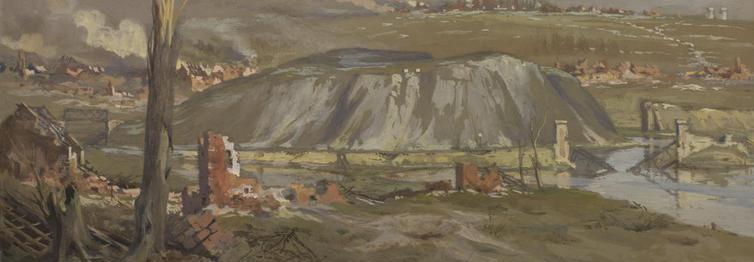
Oppenheimer was a man of principle and courage. He supported free trade and women's suffrage, great issues of their day. He enlisted as a private in the Royal Artillery at the age of forty in the service of his king and country and went to the Western Front.
After the war, he advocated the causes of ex-servicemen and spoke up for the protection of the built heritage and environment with tenacity and distinction.
With the Volunteer Battalion - "Charles Oppenheimer: From Craftsman to Artist" - Euan Robson, 1902
One day in 1902, Oppenheimer was on parade with his Battalion in Manchester. He cut an impressive figure mounted on a horse resplendent in his uniform with gleaming saddle and polished metal insignia. He was about six feet tall, lean but square shouldered with red brown hair and a typically full Edwardian moustache. He caught the attention of Constance Emily Taylor, the twenty five year old daughter of a science teacher, Robert Llewellyn Taylor FIC, FCS. An engagement followed not long after
Danger of a German Name - "Charles Oppenheimer: From Craftsman to Artist" - Euan Robson, 1914
As the war dragged on it brought a real and present danger not in France, but at home for the Oppenheimer family. Not a common name, its German origin was obvious and irrefutable, and became a target of the unthinking from the early days of the conflict. Windows were smashed by stones at Ludwig Oppenheimer Ltd's business premises in August 1914 and its sign defaced. The directors went to the length of writing to customers in November 1914 to stress their patriotism.
Niece, Mary Evans on his wartime activity - "Charles Oppenheimer: From Craftsman to Artist" - Euan Robson
Family legend
Oppenheimer's niece, Mary Evans, recalled a particularly dangerous way in which his drawing skills were put to use by the Intelligence Section. "During his wartime service he was several times flown over the war zone to make sketches of the terain." These were perilous missions in canvas-covered, wooden framed two seater BE2a bi-planes. Mary Evans continued that Oppenheimer "was often shot at from below" and the family believed that he as recommended for bravery awards for this work on three occasions but he was never decorated other than with standard service medals. "The worry was that his German name counted against him."
Rights of returning soldiers, sailors and airmen - "Charles Oppenheimer: From Craftsman to Artist" - Euan Robson
Oppenheimer was a man of conviction. Firmly on the side of free trade, strongly in support of votes for women, he was a determined supporter of the rights of returning soldiers, sailors and airmen. Oppenheimer had become the Chairman of the Kirkcudbright Post of the Comrades of the Great War (became the Royal British Legion in 1921) and on the 25th June 1919 he had given notice of a motion for the July meeting "that the Council strongly recommends that all employers of labour within the Burgh, who have not already done so, should offer to reinstate ex-servicemen in the position they held before joining the forces and that all appointments temporarily made during the War should now be cancelled and the posts permanently filled where practicable by ex-servicemen."
Kircudbright Town Council - "Charles Oppenheimer: From Craftsman to Artist" - Euan Robson
When Lehmann enlisted, Charles returned to Manchester to look after the family mosaic business and, because of this had to send his resignation to the Kirkcudbright Town Council.
The Kirkcudbright Advertiser (2nd Apirl 1915) reports that 'Provost Wallace said that they had all been put to inconvenience on account of the War. Instead of accepting Mr Oppenheimer's resignation they could give him six months' leave of absence. If the War was not finished then they could extend the leave of absence if necessary"