Isaac Henry Woolf 'Jack' Barnato
Born:
3 Sivan 5654 (07 June 1894)
Died:
20 Heshvan 5679 (26 October 1918)
Basic Information
Birth
Date of birth:
3 Sivan 5654 (07 June 1894)
Place of birth:
36 Curzon Street, Mayfair, London
Death
Date of death:
20 Heshvan 5679 (26 October 1918)
Place of death:
14 Duke Street, Mansions in Grosvenor Sqyare
Burial place:
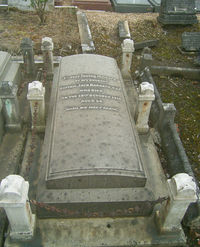
Willesden Jewish Cemetery
Places
Addresses
His home:
14 Duke Street Mansions Grosvenor Square (1918)
Parents' Home:
36 Curzon Street London (1894)
Schools
Name:
Trinity College, Cambridge
Obituary from The Times (London, England), 28 October 1918
THE DEATH OF CAPTAIN J. BARNATO
‘The death from pneumonia following on influenza of Captain Jack Barnato, R.A.F., eldest son of the late B. I. Barnato, occurred suddenly on Saturday, after a few days' illness, at 14 Duke Street Mansions, Grosvenor-square. Captain Barnato, who was 24 years old, was one of the four naval airmen who in the early days of the war bombed Constantinople. He only recently celebrated the first anniversary of his marriage to Miss D. Lewis…’
Researched for 'We Were There Too' by Dr Ronnie Fraser
Family
Spouse
Dorothe Mabel Lewis (female)
Other surname / Maiden name:
Barnato
Place of marriage:
St George Hanover Square, London
Siblings
Leah Primrose Barnato (female)
Parents
Father: Barnett Isaacs Barnato (male)
The Palgrave Dictionary of Anglo-Jewish History
The Palgrave Dictionary of Anglo-Jewish History
Homefront
Member of family in armed forces:
Brother, Joel Woolf Barnato
Military Record
Military service:
Army, Royal Naval Air Service (RNAS) and RAF
Military record no.:
37261
Date enlisted/conscripted:
15 September 1914
Date discharged/death:
25 October 1918
Rank at discharge/death:
Captain
Assignments
Posting:
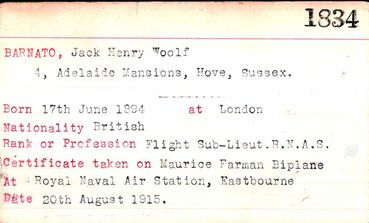
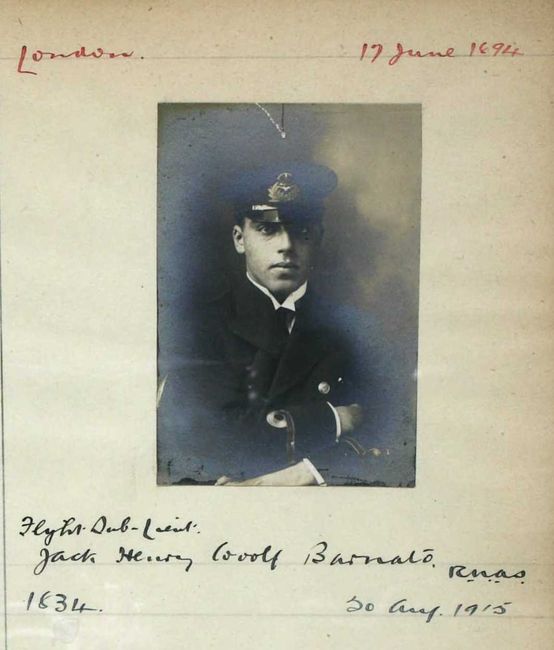
Eager to serve in World War One, Jack joined the 18th Service Battalion of the Royal Fusiliers on 15 September 1914. An Electrical engineer by profession, he transferred into the Royal Naval Air Service (RNAS) on 13 June 1915. He earned his aviator's certificate no 1834 at the RNAS base at Eastbourne on 20 August 1915.
After having made a poor start to his flying career while learning at Eastbourne Jack matured into a first class pilot. In his time with the RNAS he had gained a wide experience having flown many types including the Sopwith Camel and Strutter, the DH4, the BE2-C, the Bristol Scout, Maurice Farman Shorthorn and Longhorn, as well as Bleriot, Neuiport, Fairey, Caudron and Curtiss aeroplanes
On 13 October 1915 Jack was posted to Salonika in the Eastern Mediterranean where he served until February 1917 when he returned to the UK he served as a Flight instructor at Eastchurch Flying School and for a time on active service in Flanders, at Dunkirk, and then held a very responsible position in London in the Technical Department with 217 squadron at RAF Cranwell.
Campaigns:
The Raid on Constantinople 14 April 1916
On the stormy night of April 14-15, 1916, three B.E.2-c bombers from the British Royal Naval Air Service (RNAS) bombed Constantinople and Adrianople. Operating from Mudros in Salonika two of the aircraft of C Flight dropped bombs on the Zeitunlik powder mills and the Demirkhan gun factory, while a third aircraft dropped bombs on the railway station at Adrianople.
The raid was led by Squadron-Commander Joseph Ruscombe Wadham Smyth-Piggott. The other fliers on the raid were Flight Lieutenant Kenneth Stevens Savory, Flight Sub-Lieutenant Richard Sebastian Willoughby Dickinson and Flight Sub-Lieutenant Isaac Henry Woolf "Jacky" Barnato.
There had been other air raids against Smyrna and Gallipoli from Mudros and elsewhere in the Aegean, but this raid was a round trip of 300 miles and drew attention at the time as it was the longest round trip ever attempted for a bombing raid. While doing little damage it reportedly alarmed the population and gave them the message that Istanbul was not untouchable. For his part in the raid Isaac was mentioned in despatches.
6 November 1916
A Maurice Farman piloted by Flt Lt Barnato with his Observer, Sub Lt A.E.H. Roberts R.N.V.R. was searching for guns at Cape Chemali on which to spot for Monitor M.33. It was attacked by a Fokker monoplane at a height of around 5,000 ft. The Fokker fired from behind at close range and damaged the Farman’s radiator. Barnato side-slipped his machine on two occasions causing the Fokker to overshoot which enabled his Observer’s Lewis gun to be brought into action. Owing to the damage to the radiator their engine failed through overheating and Isaac was forced to ditch close to M.33 Both Barnato and Roberts survived the crash and were unhurt.
The Fokker was engaged by the Monitor's A.A. guns. The Fokker was described as being somewhat larger than a Bristol Scout and had black rectangular patches painted on the wing tips instead of the usual black cross.
Medals:
Victory & British War Medals
Roll of Honour
J. I. BARNATO, 26 October 1918
Commonwealth Graves Commission
Date of Death:
25 October 1918
Regiment / service:
Royal Air Force
Cemetery:
Willesden Jewish Cemetery, United Kingdom
Grave reference:
J. D. 18.
Gallery