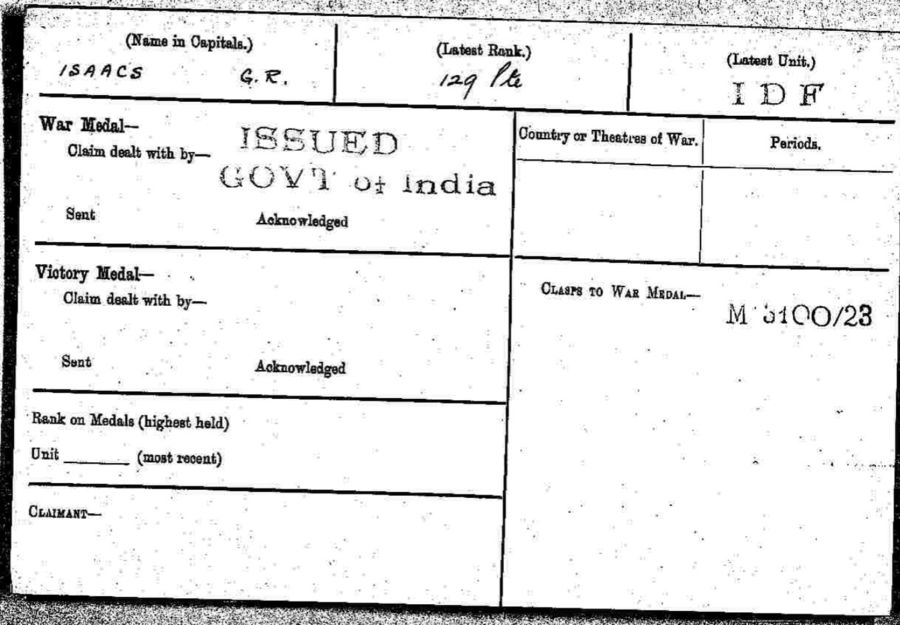
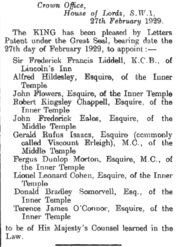
2nd Marquess of Reading GCMG, CBE, MC, TD, PC, QC. He was styled Viscount Erleigh from 1917 to 1935, was a British barrister and Conservative politician. He was the son of Rufus Isaacs, 1st Marquess of Reading, and Alice Edith Cohen. He was educated at Rugby School and Balliol College, Oxford. He served in the First World War, winning the MC and reaching the rank of Lieutenant Colonel. succeeded his father as second Marquess of Reading in 1935. When the Conservatives came to power in 1951 under Winston Churchill, he was appointed Joint Parliamentary Under-Secretary of State for Foreign Affairs, a post he held until 1953, when he was promoted to Minister of State for Foreign Affairs and admitted to the Privy Council. He retained this position also when Sir Anthony Eden became Prime Minister in 1955.
https://www.findagrave.com/memorial/90106835/gerald-rufus-isaacs
JC Obituary - The Marquess of Reading, 30 September 1960
The Marquess of Reading, whose death was announced last week, was the son of one of the greatest public figures produced by the Jewish community, Rufus Daniel Isaacs, whose exalted offices included Attorney-General, Lord Chief Justice, and Viceroy iof India. His mother was Alice Edith, Daughter of Albert Cohen, a City of London merchant.
While he did not achieve the fame and eminence of the first Marquess, Lord Reading went far in two of his father's spheres of activity—the legal profession and Goverament service: while to Jewish causes he devoted himself to a greater extent than the first Marquess.
Gerald Rufus Isaacs, who was born in London, began his education at Rugby. He was only 15 when he first experienced the hurly-burly of politics: he helped his father in Reading in 1904 – when he first won a Parliamentary seat. Young Gerald went from Rugby to Balliol College, Oxford, and while at the University took a keen interest in its political life: he was President of the leading Liberal Club, the Russell. He was called to the Bar at the Middle Temple in 1912.
On the outbreak of war in August 1914, he joined up in the Royal Fusiliers. A month later he was married to the Hon. Eva Violet Mond, eldest daughter of the first Lord Melchett. He served in France through the war, being mentioned in despatches and winning the Military Cross and the Croix de Guerre.
At the Bar Viscount Erleigh—the title he took on his father's promotion to the Marquisate in 1926 - quickly made a name for himself. He was appointed a K.C., in 1929, on the same day that Lionel (now Lord) Cohen took silk. In that year, too, he stood as Parliamentary candidate for Blackburn in the Liberal interest. Also in 1929 he assisted Sir Boyd Merriman as legal representative of the Jewish Agency, at the inquiry into the Arab riots.
He was then taking an increasing interest in Jewish organisations. In 1934 he became a member of the Council of Administration of the Jewish Colonisation Association (which he served later as a President), and in the same year was appointed President of the London Jewish Hospital, a position he held for 12 years. During his presidency of the hospital much progress was made in improvements and extensions. He was Chairman of the £60,000 appeal for building the nurses home.
Refugee Problem
On the death of his father in 1936, Viscount Erleigh became Marquess of Reading. His maiden speech in the Lords—a speech that earned him the general congratulations of the House —was in support of the Public Order Bill necessitated by the fascist campaign in the East End of London, "It would be idle to pretend,” he said, “that one of the main reasons for the introduction of the Bill was not to be found in the attacks made upon the Jewish community.” He went on to speak of the Jews’ achievement, after a long struggle, of equality with their follow citizens and said that since then “they have asked for nothing more than the elementary right of every citizen to go about his legitimate business freely and in peace. They have no desire today to be made the stalking horse either of fascism or of communism.”
The mischievous anti-Jewish movement in this country was an echo of the growing and horrifying persecution on the Continent, and in the efforts made here to help the victims of Nazism Lord Reading played an important part. The problems of the welfare and resettlement of German refugees became more serious, as the Second World War approached its end. In speeches in the House of Lords Lord Reading criticised the slowness of the Allied Governments in dealing with these matters and came t the defence of the refugees when their infiltration into the life of this country was discussed. He was Chairman of the Council for German Jewry and presided over the launching of a £1 million appeal by the Central British Fund for Jewish Relief and Rehabilitation in Europe.
He took a leading part at the beginning of the Second World War in the moves to enable refugees to join the Auxiliary Military Pioneer Corps. Which he commanded as Lieut-Colonel. From 1943 to 1945 he was Brigadier and Director of Kabour at the headquarters of the 21st Army Group. The C.B.E. (Military Division) was awarded to him. In 1947 he was elected President iof the Association of Jewish Ex-Servicemen and held the office for three years.
Joined Conservatives
It was generally thought, in 1949, that Lord Reading would take over the leadership of the Liberal Peers on the retirement of Lord Samuel, but in 1950 her left the Liberal Party to join the Conservatives. After 18 months he was appoinyted Joint Parliamentary Under-Secretary of State for Foreign Affairs, and two years later he became Minister of State, Foreign Office, and a Privy Councillor.
During his three years as Minister of State he won high regard as an impressive and eloquent British Representative among Foreign Office officials and in the Diplomatic Corps, as well as in the many capitals to which he travelled. When Mr. Macmillan formed his Government in January, 1957, the Marquess of Reading was not included. He was made a Knight Commander of the Order of St. Michael and St. George and the Marchioness received the C.B.E.
At the State opening of Parliament in 1956 Lord Reading was honoured by being chosen to carry the Cap of Maintenance and walk immediately in front of the Queen in the procession from her robbing room to the House of Lords. That year was the tercentenary year for the Anglo-Jewish community. Lord Reading was a Vioce-President of the Council concerned with the celebrations and one of the speakers at the Guildhall dinner at which also the Duke of Edinburgh and the Prime Minister (Sir Anthony Eden) were among those who spoke. His speech on that occasion, as on numerous others, sparkled with wit and humour.
At the end of 1958 he was appointed Chairman of the Council of Tribunals set up to supervise the working of administrative tribunals under the Tribunals and Inquiries Act.
He was a Vice-Chairman for some time of the Council of Christians and Jews, and in 1947 was co-Chairman of the International Conference of Christians and Jews. His interest in Jewish cultural matters was evident in his connection with the Society of Jewish Study, of which he was a Trustee.
The Marquess published several books and articles. He wrote an account of the South Sea Bubble but his best known and most successful literary effort was a two-volume work on the life of his father.
His widow, the Marchioness of Reading, has been very active in Jewish affairs tow of her offices being President of the British Section of the World Jewish Congress and President of the Functions Committee of the Jewish National Fund. He is survived by her and jby a son and two daughters. The son, who succeeds to the title is Michael Alfred Rufus Isaacs. One of the daughters of the late Marquess is married to Sir Solly Zuckerman, the scientist.
The funeral service for thre Marquess of Reading, held at ther Golfers Green crematorium on Sunday was conducted by Rabbi Dr. Leslie Edgar, Senior Minister of the Liberal Jewish Synagogue. A memorial service is to be held on October 10 at the West London Synagogue.