The Casualties
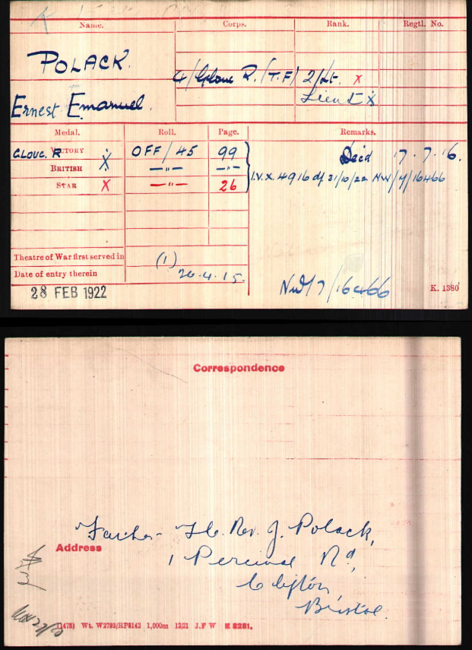
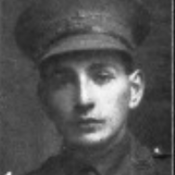
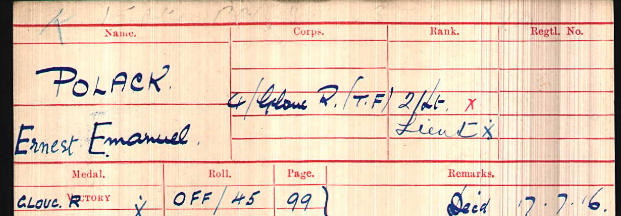
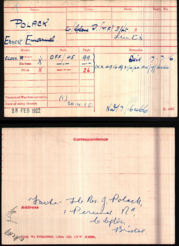
Jews are sharing fully in the terrible price of life and limb which is being paid by the country in its fight for world freedom. To all who are suffering our deepest sympathy goes out, while to those brave soldiers whose "pain is ended" we reverently bow our heads in admiring gratitude. Among those who have fallen we deeply regret to see the name of Lieut. Ernest. E. Polack. The Rev. J. Polack of the Jewish House at Clifton College has thus lost a second son in the war. His first son to fall - Second Lieut. B. J. Polack was killed in Mesopotamia three months ago.
Lieut. Polack was a young man of the highest character who shaped his whole life in accordance with the noblest standards as he conceived them. Like so many other coreligionists who have given their all to the State, he was a type of the Jew who is possessed of a love for his native country which is pathetic in its exquisite tenderness, and of a belief in England's cause, which moves us by its passionate conviction. Surely no nobler reward than such splendid young lives as these ever fell to a land which made righteousness the corner stone of its policy; and as surely no family, or indeed community, has been called upon to brave more bitter losses than those which it is our melancholy duty to record week by week.
For although the death of Lieut. Polack is most painful to his own immediate relatives, it is a bereavement, also, to the community, whose hopes for its future were built upon such careers as those we now mourn. To Mr and Mrs. Polack - the heartfelt sympathy of all their coreligionists respectfully tendered.
The Late Lieut. Ernest E. Polack - His Last "Testament"
My Dear Mother and Father - this is not an easy letter to write and I have long refrained from writing it; but now that the Advance seems more than a remote possibility, and is in fact due to start tomorrow, I had better realise at once that I may not get through it. In fact, I consider it very unlikely that I shall get through it whole. Death has no terrors for me in itself, for (like Cleopatra) "I have immortal longings in me." The prospect of pain naturally appals me somewhat and I am taking morphia in with me to battle.
We are in Corps Reserve behind ---- and, should all go well, will not be called upon until the second night and then shall probably be resisting a German counter-attack somewhere near ---- . But our services may be required at any moment.
I have little to leave except my love and gratitude. I should like most of my Shakesperian books to go to Albert. My set of Dickens I should like to be given to Phil. I do not wish Desmond, Ronald or Ruth to be forgotten. I should like to give some of my books to Aunt Flora (my Dickens picture book), Aunt Bona, Dorothea and Jack Berlin. I think that perhaps Uncle M would like to have some of my Oriental language books. I should also like Minna to have something - I have had such a happy life compared with her family. I should like to have a special gift sent to Aunt Cecily. To Aunt Reb, Sis and Uncle Phil, my very very keen love.
I want my captured flag to go to my regiment.
I can think of nothing else at present. I have old associations with the North-East Hospital for Children, Bethnal Green and the Great Ormond Street Hospital (where Johnny Harmon died) and should like to give something to each.
For the rest - "If 'tis not now, 'twill be to come." Our cause is a good one and I believe I am doing right in fighting.
To you - Mother and Father - I owe all. The thought of you two - and of my brothers - will inspire me to the end. I often wish Albert was with me and miss him dreadfully.
Good-bye!
"If we shall meet again, why then we'll smile. If not - why then this parting was well made" - (Julius Caesar)
Your loving son,
Ernest
I will ask Mr. Ramsay (our Chaplain) to send you this if I fall.
The Fallen. - The Late Lieut. Ernest E. Polack
Lieut. E. E. Polack, Gloucester Regt., who was killed on July 17th, age twenty-three was the youngest son of the Rev. J. Polack, Housemaster of the Jewish House at Clifton Cllege. Hew as educated at Clifton and in 1912 he was elected to an open exhibition at St John's College, Cambridge and also gained a Stewart of Rannoch Scholarship in Hebrew. At the end of two years' residence at the University his college awarded him a scholarship in Semitic languages in addition to numerous prizes. He was a frequent speaker at the Union and was elected a member of the committee. Both at Clifton and Cambridge, he was a member of the O.T.C. When War broke out he was keeping a "long term" but he immediately went into training and obtained a commission in the Gloucester Regt. towards the end of August 1914. Since April 1915, he had been at the front with his battalion and had been frequently in command of his company. In January last he gained much commendation by capturing during a night patrol a German flag, which had been defiantly fixed in front of the enemy's trenches. His eldest brother, 2nd-Lieut. B. J. Polack was killed in Mesopotamia three months ago and his surviving brother Lieut. A. J. Polack is an officer in the Royal Engineers.
Lieut. Polack took a keen interest in the affairs of the Cambridge Hebrew Congregation. He frequently read the services and occasionally acted as Baal Koreh. Side by side with his Hebrew studies, he read English literature with an intense interest and enjoyment and his letters to friends teemed with quotations from the Bible, Shakespeare, Tennyson and Dickens, in all of which works he found the greatest solace amid his arduous duties at the front. Military pursuits were indeed entirely uncongenial to his nature but he discharged his duties with a thoroughness characteristic of him, simply because he believed his country needed him. He was an enthusiastic members of the Dickens Fellowship and contributed occasionally to the organ of that organisation, the Dichensian, which, in one of its recent editorials, spoke appreciatively of his work. His last letter, written on the eve of battle concludes with a quotation from Julius Caesar.
Through his death an experiment which was to have been tried, has been frustrated. His intention had been to qualify for the pulpit and it would have been see whether there was a place in the Jewish ministry of this country for a candidate imbued with the traditions and spirit of a great English Public School, one who combined with Jewish scholarship and a deep devotion to his faith, a love of cricket, football, riding and all manly sports, and who viewed life and duty from a lofty public-spirited standpoint. He expressed the wish that the German flag which he captured should be presented to his regiment.
The Rev J. Polack received the following letter from the Rev R. E. Ramsay, Chaplain to the late Lieut. Polack's Regt: -
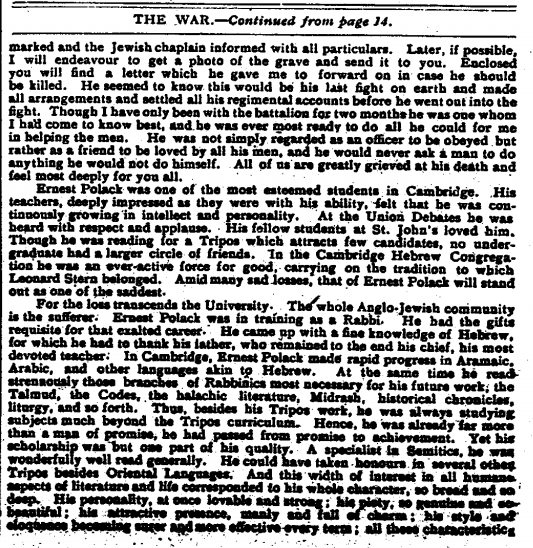
"Dear Mr Polack - it is very hard for me to write this letter to you. We met occasionally at St Agnes, and I can indeed sympathise with you in the death of your son in the battalion. Your family has, in very truth, made the greatest sacrifices for right and truth. Lieut. Polack died nobly leading his men in the attack on the German front line on the night of Sunday, July 16th. The trench was captured and is held by us at the cost of many of our best men. Lieut. Polack was killed instantly by a shell just before the trench was reached. We hope it may be possible to arrange a funeral in accordance with his faith, and, if not now, later and meanwhile the place where his body rests shall be carefully marked at the Jewish chaplain informed with all particulars. Later, if possible I will endeavour to get a photo of the grave and send it to you. Enclosed you will find a letter which he gave me to forward on in case he should be killed. He seemed to know this would be his last fight on earth and made all arrangements and settled all his regimental accounts before he went out into the fight. Though I have only been with the battalion for two months, he was one whom I had come to know best and he was ever most ready to do all he could for me in helping the men. He was not simply regarded as an officer to be obeyed, but rather as a friend to be loved by all his men, and he would never ask a man to do anything he would not do himself. All of us are greatly grieved at his death and feel most deeply for you all.
Ernest Polack was one of the most esteemed students at Cambridge. His teachers, deeply impressed as they were with his ability felt that he was continuously growing in intellect and personality. At the Union Debates, he was heard with respect and applause. His fellow students at St John's loved him. Though he was reading for a Tripos which attracts few candidates, no undergraduate had a larger circle of friends. In the Cambridge Hebrew Congregation he was an ever-active force for good, carrying on the tradition to which Leonard Stern belonged. Amid many sad losses, that of Ernest Polack will stand out as one of the saddest.
For the loss transcends the University. The whole Anglo-Jewish community is the sufferer. Ernest Polack was in training as a Rabbi. He had the gifts requisite for that exalted career. He came up with a fine knowledge of Hebrew for which had had to thank his father, who remained to the end his chief, his most devoted teacher. In Cambridge, Ernest Polack made rapid progress in Aramaic, Arabic and other languages akin to Hebrew. At the same time he read strenuously those branches of Rabbinics most necessary for his future work, the Talmud, the Codes, the halachic literature, Midrash, historical chronicles, liturgy and so forth. Thus, besides his Tripos work, he was always studying subjects much beyond the Tripos curriculum. Hence, he was already far more than a man of promise, he had passed from promise to achievement. Yet his scholarship was but one part of his quality. A specialist in Semitics, he was wonderfully well read generally. He could have taken honours in several other Tripos besides Oriental Languages. And this width of interest in all human aspects of literature and life correspond to his whole character. His personality, at once lovable and strong, his piety so genuine and beautiful, becoming more effective every term; all those characteristics.