Basic Information
Birth
Date of birth:
21 Tammuz 5654 (25 July 1894)
Death
Date of death:
10 Iyyar 5675 (24 April 1915)
Cause of death:
Killed in action by shellfire
Burial place:
YPRES (MENIN GATE) MEMORIAL Panel 54.
1 of 3
Book of Honour photo
2 of 3
David
3 of 3
David
1 of 3
Book of Honour photo
2 of 3
David
3 of 3
David
Places
Schools
Name:
Kilburn Grammar School
Life before the war
David went to Canada as a young man, sailing 9th March 1912 on SS Virginian from Liverpool to Brunswick (Nova Scotia). He returned 10th October 1914 on SS Philadelphia from New York to Liverpool and returned home to London; enlisting with the 9th (County of London) Battalion, Queen Victoria Rifles.
David's story written by his Great Nephew
David Van Ryn was one of the newer members of the British race in 1915. He was the 20-year-old son of Dutch immigrants.
He was my great uncle. His parents kept the letters David wrote from the war.
Over the decades, those letters have been passed on. My mother recently gave them to me.
The first is a postcard dated 22 January 1915.
"Dear Father and Mother," David writes, "we embark for France at 2pm today. Further address: Queen Victoria Rifles, Expeditionary Force, France."
He signs off with: "Au Revoir, Dave."
Over the next three months come a series of letters, written in purple pencil on small lined paper. (see some examples below)
Then on 30 April comes a short letter in the same neat, cursive script as all the others... except that this begins: "Dear Mr and Mrs Van Ryn".
It is from Lance Corporal H J McMorran.
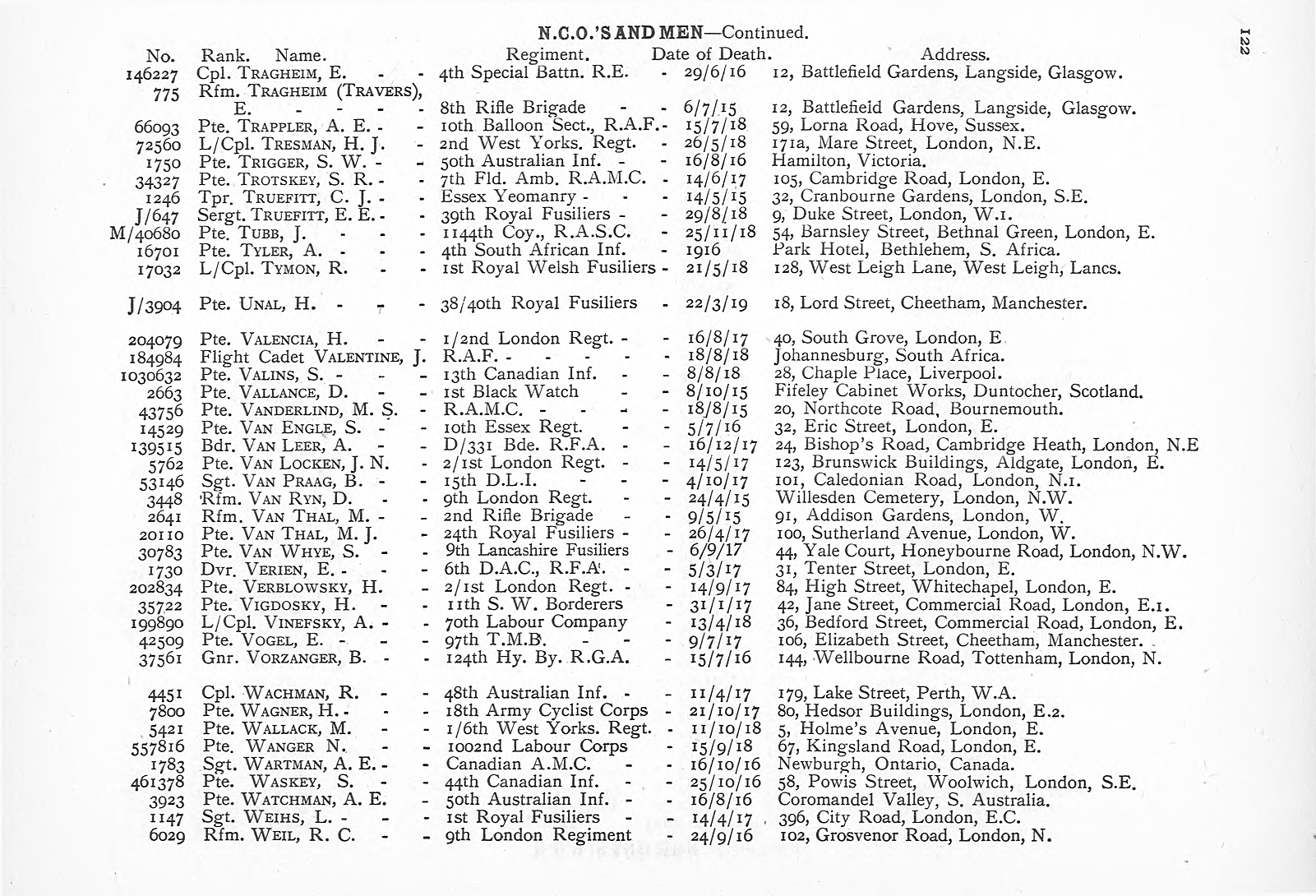
"It is with the deepest regret that I have to inform you of the death of your dear son, Number 3448 Rifleman D Van Ryn."
The details are scant, and the sympathy understandably formulaic.
It is a month later when Corporal McMorran sends another, longer letter that begins with an apology for his tardiness: the fighting had consumed all his time.
It transpires that David had spent five days fighting in the Battle of Hill 60.
In the flat, featureless landscape of west Flanders, this small hillock was seen as strategically vital. (Hill 60 was the spoil heap from making a Railway Cutting.)
In the battle, the British won it from the Germans. But, nearby, on the day that David finished fighting at Hill 60, the Germans had first used gas against French and Algerian troops.
The French lines were ravaged.
Two days later, the Germans launched another gas attack, this time against the Canadians, positioned just north of Ypres.
It was for this reason that David's battalion was ordered to march north to reinforce the Canadian lines.
They had almost made it, when three shells dropped in their midst.
Nine men were killed.
David had been hit in the neck.
As Corporal McMorran puts it: "He just asked for our officer and then he knew no more."
There he was buried, just to the east of Weltje-Sint Jan road.
The road still exists but David's grave does not.
When a burial party went to recover the body, it had been hit and dispersed by a second shell, hence the name on the Menin Gate.
Letters from David
Family politeness and trivia nestle between the wearisome violence of war, the miles of fruitless marching, the sniping at the Germans - David had been made a machine gunner - and the frostbite.
The trenches are filled with freezing standing water, six inches to a foot deep.
"It does not bother me much," he tells his parents. "Other than the frostbite, I am feeling in splendid shape."
On 11 April, David writes from his billet, having only arrived back there at 0330 that morning.
He had spent five days "in the firing line", as he puts it, in a sandbagged trench.
"The last days the weather turned very fine," he writes, "and we bailed out the water and everything was lovely.
"Being Easter time we thought we would have some Bank Holiday spirit, so we put up dummies and started throwing things at them at the rear of the trenches.
"There were Welsh engineers with us who were fine singers, so we had some concerts. All this," he remarks, "with the Germans 50 yards away.
"You see war is not so awful after all. Had you been in the trenches you might have thought us callous, for it's an old French trench and they have a nasty habit of leaving their dead where they fall or throwing them to the rear.
"There were dozens of them lying around and the parapet was largely built up with them."
David then thanks his parents for a parcel they have sent.
He politely asks if they might send some cigarettes next time, especially as: "I have now quite a reserve of handkerchiefs and shall not need any more for a long time."
(BBC Radio 4 Correspondent, Tim Franks - 29/04/2006)