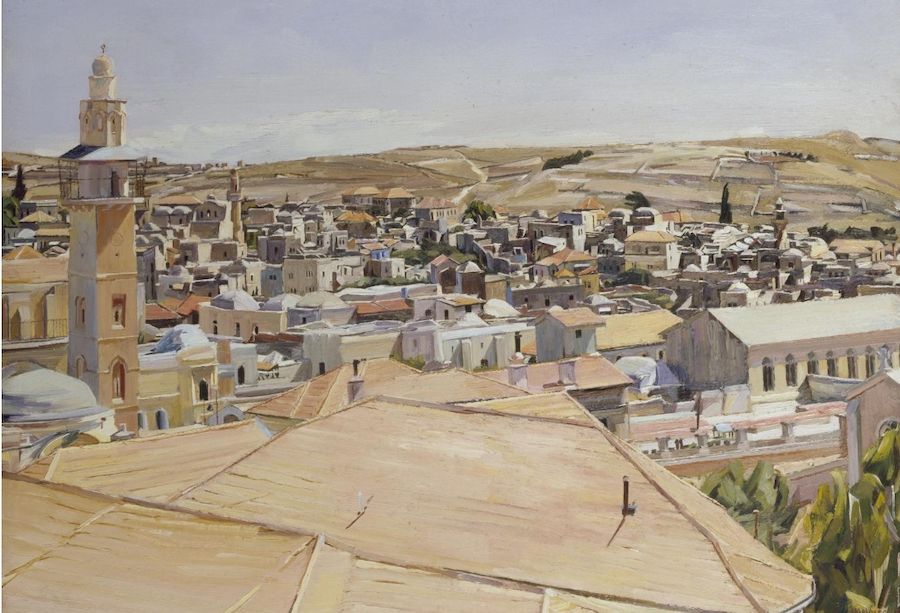
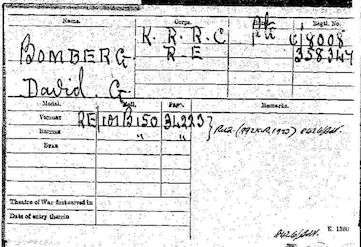
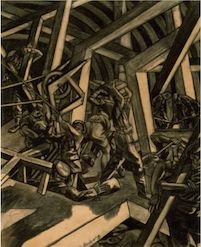
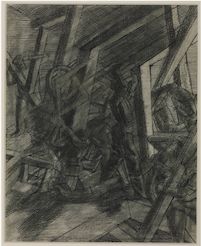
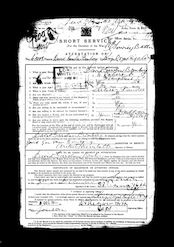
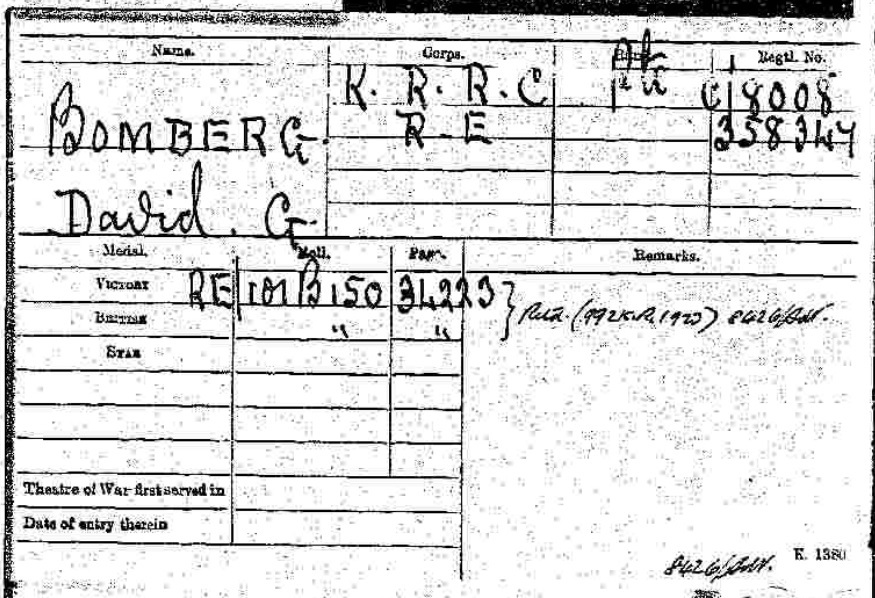
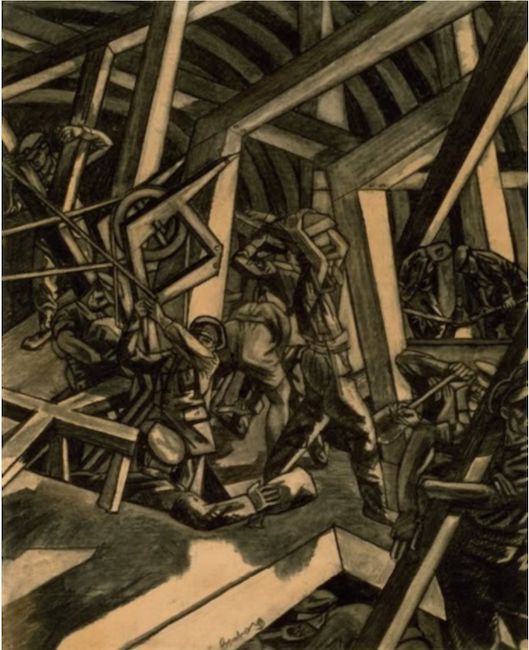
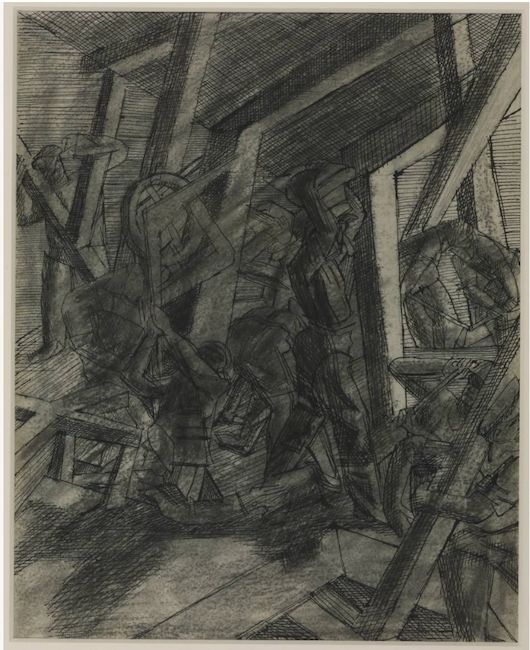
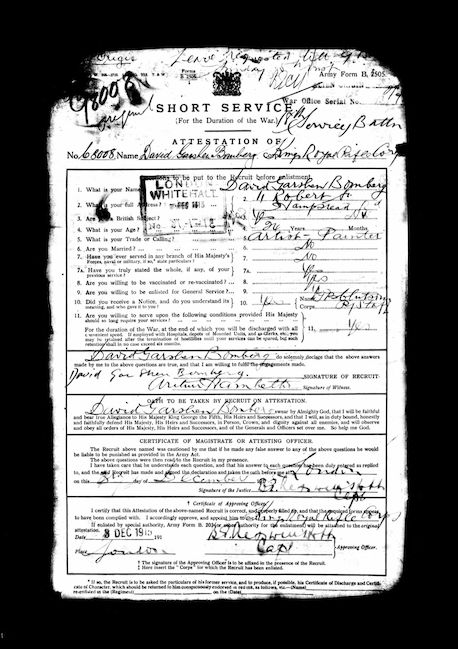
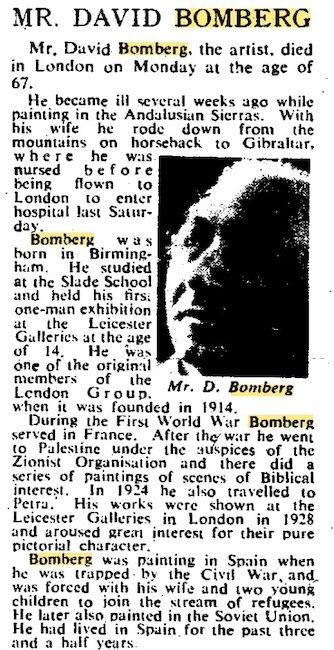
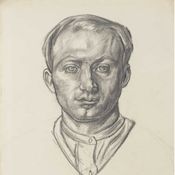
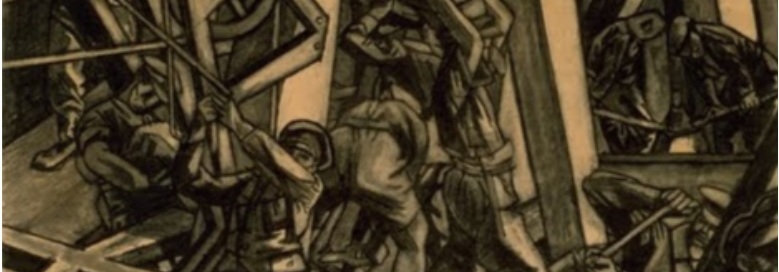
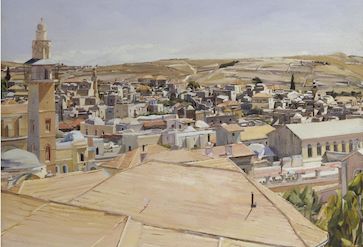
During the First World War Bomberg enlisted in the Royal Engineers and was transferred to the 18th King's Royal Rifles. In 1917 he was commissioned to produce a painting, `Sappers at Work', for the Canadian War Memorials Fund. The first version, which drew on the geometrical abstraction of most of his pre-war work, was rejected, but a second, more conventional picture, was accepted for the National Gallery of Canada. After the war David Bomberg declined an invitation from his friend the architect Robert van't Hoff to join De Stijl in Holland. In September 1919 an exhibition of his ink-wash drawings was shown at the Adelphi Gallery in London and the Mansard Gallery held an exhibition of his drawings in March 1923. In April 1923 David Bomberg travelled to Jerusalem with financial support from the Palestine Foundation Fund and at the recommendation of Sir Muirhead Bone (1876/1953). He made a six-month visit to Petra in the following year. While in the Middle East David Bomberg painted more naturalistic landscapes than might have been expected from his pre-war work. Following his return to London works from Palestine and Petra were exhibited with critical success at the Leicester Galleries in February 1928 and, four months later, in the artist's London studio. In February 1929 similar works were also exhibited at the Ruskin Gallery in Birmingham. David Bomberg first visited Spain in August 1929 and painted for the most part in Toledo. He returned to Spain in 1934, visiting the Asturias, Cuenca, and the town of Ronda in Andalucia. Civil unrest forced his return to England late in 1935. An exhibition of `Sixty Imaginative Compositions, Spanish and Scottish Landscapes and Other Works' was held at the Bloomsbury Gallery in London in November 1932, and, in June 1936, an exhibition of `Recent Paintings of Spain' was shown at the Cooling Galleries. In January 1937 David Bomberg held a retrospective exhibition at the Foyle Art Gallery together with Horace Brodzky and Margarete Hamerschlag. He joined the Communist Party in 1933, with the encouragement of his sister Kitty and her husband, James Newmark, but resigned his membership after spending six months in the Soviet Union, in December 1933. During the Second World War David Bomberg made numerous unsuccessful applications for teaching posts. In 1942 he received a commission from the War Artists' Advisory Committee to paint a bomb store in Burton-on-Trent but his finished painting did not meet with the approval of the committee. The last one-man show held during Bomberg's lifetime was an `Exhibition of Imaginative Compositions' at the Leger Gallery in November 1943. DB eventually found part-time employment as a teacher of drawing at the Bartlett School of Architecture (1945/49) and, with considerable success, at the Borough Polytechnic, between 1945 and 1953. His pupils included Frank Auerbach, Cliff Holden, Leon Kossoff, Leslie Marr, Dorothy Mead, and Gustav Metzger.
https://archiveshub.jisc.ac.uk/search/archives/e1a8efbf-882e-35bc-8b92-dbf362a42a54
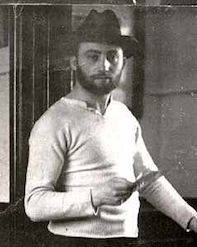
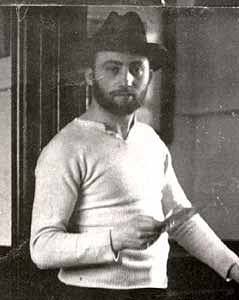
David Garshen Bomberg (5 December 1890 – 19 August 1957) was a British painter, and one of the Whitechapel Boys.
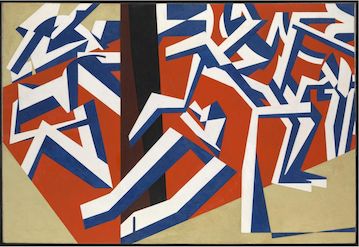
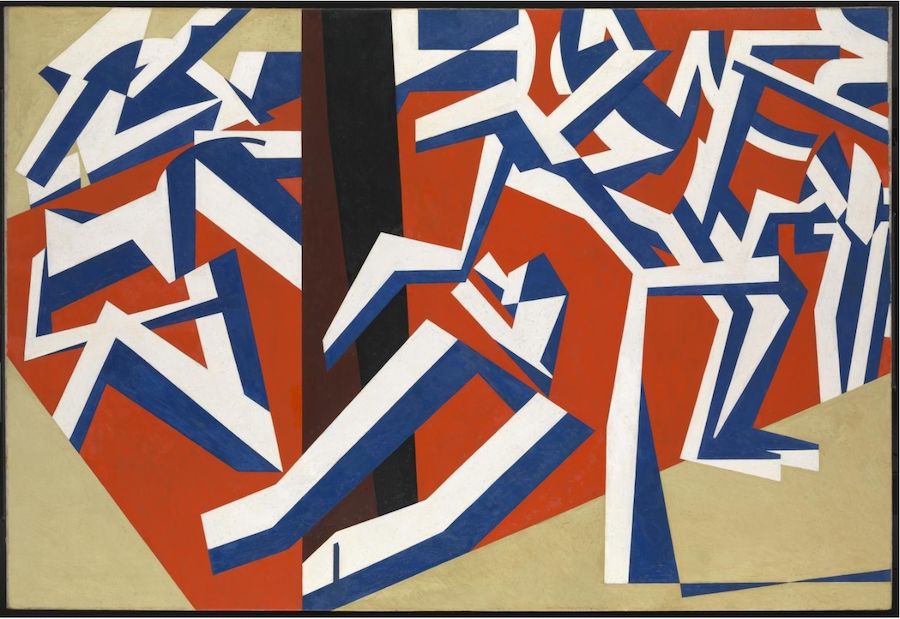
Bomberg was one of the most audacious of the exceptional generation of artists who studied at the Slade School of Art under Henry Tonks, and which included Mark Gertler, Stanley Spencer, C.R.W. Nevinson, and Dora Carrington. Bomberg painted a series of complex geometric compositions combining the influences of cubism and futurism in the years immediately preceding World War I; typically using a limited number of striking colours, turning humans into simple, angular shapes, and sometimes overlaying the whole painting a strong grid-work colouring scheme. He was expelled from the Slade School of Art in 1913, with agreement between the senior teachers Tonks, Frederick Brown and Philip Wilson Steer, because of the audacity of his breach from the conventional approach of that time.
Whether because his faith in the machine age had been shattered by his experiences as a private soldier in the trenches or because of the pervasive retrogressive attitude towards modernism in Britain Bomberg moved to a more figurative style in the 1920s and his work became increasingly dominated by portraits and landscapes drawn from nature. Gradually developing a more expressionist technique, he travelled widely through the Middle East and Europe.
From 1945 to 1953, he worked as a teacher at Borough Polytechnic (now London South Bank University) in London, where his pupils included Frank Auerbach, Leon Kossoff, Philip Holmes, Cliff Holden, Edna Mann, Dorothy Mead, Gustav Metzger, Dennis Creffield, Cecil Bailey, and Miles Richmond. David Bomberg House, one of the student halls of residences at London South Bank University, is named in his honour. He was married to landscape painter Lilian Holt.
https://en.wikipedia.org/wiki/David_Bomberg