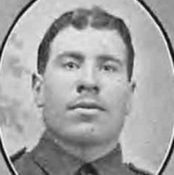

All that we know about Corporal J. R. Baker are that he wrote five letters from the trenches to the Jewish Chaplain, Reverend M Adler and the Jewish Chronicle.
Corporal J. R. Baker served as a strecher-bearer for C company, 2nd Battalion, Scottish Rifles with the British Expeditionary Force in France in 1914 and 1915. He was injured in the attack on Fromelle on the 9 May 1915 and repatriated to VAD hospital at St Augustine’s Hall, Rickmansworth, Hertfordshire where he recovered from his wounds.
He then went on to serve in the Labour Corps.
His first letter which was published in the Jewish Chronicle on 25 December 1914 was written to the Chaplain;
"Your kind letter and parcel of the 2nd inst. duly to hand, for which kindly receive my sincere thanks. I was specially delighted with the large scarf, and I can assure you I shall make every possible use of it every time I go into the trenches. As you remark, the weather is very cold here, but somehow or other, I feel a jolly sight healthier now than I was before, in spite of the cold, though I'm sorry to say I have not felt my toes for nearly a fortnight. This, however, does not in any way interfere with my marching.
We have been here already over a month, and it has been a month full of interest. I shall never forget my first experience under fire. Directly we arrived in the neighbourhood we went to the trenches. Hardly any of us guessed at the time that we were in the firing line. The day before we left for the trenches, we were told we were going into the reserve trenches, and the second night after we got into them we went out to dig some trenches further an<> Just as we were about to start digging, the Germans opened heavy fire, and for fully three-quarters of an hour we were subjected to heavy shrapnel and rifle fire. I am glad to say that after all the hundreds of pounds wasted by the Germans there was only one casualty. Personally, I have had sane very narrow escapes, but so far, thank God, German bullets have not found me. A few days ago we were digging a grave for a chap who had got shot by a stray bullet. I bent down to lift a shovel, when a bullet whizzed past above me and hit a tree about half a yard to my right. I stood up in the same attitude as I was before, and found the hole in the tree in line with my head. I said nothing but I thought a lot.
We don't see much at present, but we do eat, we drum up (as we call eating) about six times a day, sometimes we forget we have eaten and start over again. I think it is splendid to get so much food, because, well, it keeps us busy, seeing the Germans refuse to came out of their holes.
One other fact I have noticed, and which is most regrettable, is the number of refugees driven daily from their hearths and homes to plod their way, where? Heavens, if the people at hone could only realise the terrible suffering of these poor people, the agonising cries of the infants crying for what they cannot receive, the utter destruction of all they prized most in the world, if they could only understand for a moment what their own hones would be like if the Germans had ever succeeded in landing in England, they not would not wait to read the 'Call to Arms,' or sit quietly to listen to the lectures on the subject, or to sit at home and read about the glorious feats of our troops, but would rush up in their thousands to enlist, perhaps not to fight yet, but to show the Huns we are all there at the finish. I have often wondered when I see such sights as I have described, why the Government does not take the necessary steps to ensure that every available man receives some training , if only for half an hour each day..."
Jewish Chronicle 29 January 1915
AN APPEAL FOR FIRST AID MATERIAL
Corporal J. R. Baker, C Company, 2nd Battalion, Scottish Rifles, British Expeditionary Force writes to us as follows :—
“May I take this opportunity of writing to you and asking if you will be so kind as to ask your readers, on behalf of my fifteen comrades and myself, who are stretcher-bearers of my regiment, for a few medical requisites such as scissors, bandages, gauze, wool, or any antiseptics, which would be available for use for wounded men in the trenches. The ordinary field service dressing, is quite inadequate for severe wounds; and as such men who receive these wounds have to be kept in the trenches until dark, it often happens that they lose a great deal of blood which seriously retards their recovery. May I add to this another important item which I have forgotten to mention, cheap pocket electric torches, so as to enable us to see the wounds and bandage them at night-time, would be very useful. I am writing this in the trenches so that you will readily see what prompted this letter to you. We would all I am sure highly appreciate these gifts, which would be of Inestimable value to our wounded comrades. I shall be pleased to distribute equally any such articles I may receive among my fifteen comrades."
Jewish Chronicle 26 March 1915
From Corporal J. R. Baker, 2nd Battalion, Scottish Rifles
"As you are already well aware, by perusing the papers, we captured some very important positions in which, I am glad to say, my regiment not only took a foremost part in but made a name for themselves. Within half-an-hour we had captured the first four German trenches, and by noon with the help of our sup¬ports we were able to drive the Germans into a wood and capture Neuve Chapelle.
No pen can describe the ferocity with which our chaps attacked the Germans. Neither can they be blamed if the Germans suffered terribly in consequence. Ever since our arrival here we have been doing nothing but trench work, and we lost a good many men on this account. On one occasion I heard a dying man ask the commanding officer if they are never going to get their own back, but simply go in and get killed. The chance of revenge which everyone was begging for had arrived and each took full advantage of it. There were no half measures. The Germans were simply routed, leaving everything and running like anything, with our boys after them. We were far too quick, even for our supports, otherwise I have no doubt we would have finished somewhere on the German border. Of that you will hear more shortly. The troops are mad to get on, and the GOC has promised that we shall realise our hopes shortly, and if the GOC says so it must be so. ….
I am sorry to say that at the commencement of the battle Stanley got wounded in the right arm, but not before he had taken part in capturing the third German trench, which was captured in about a quarter of an hour. As I was too busy to attend to him myself, I wished him good luck and good-bye and directed him to the ambulance…..”
Jewish Chronicle 26 March 1915
GIFTS TO SOLDIERS AT THE FRONT, SUCCESS OF APPEAL IN THE JEWISH CHRONICLE
Some time ago we inserted an appeal sent to us from the front by a few Jewish stretcher-bearers, for lint and other necessities. The pupils of the Somerset House School immediately responded to the appeal and sent a parcel of necessary and useful articles.
In anticipation of the receipt of the parcel, Corporal J. R. Baker, in the course of a letter to Miss Shasdel writes:
"I am glad to learn that my appeal in the Jewish Chronicle has met with so much success. Being at present in the trenches I am unable to state if your parcel has arrived. The actual date of my writing this letter is 26th February so you will see that my letter is post-dated for the day I get relieved here. In anticipation of its arrival please accept and convey my thanks to all your pupils who have contributed to the parcel my sincere thanks and the thanks of all those who will directly or indirectly benefit your handsome present….”
Jewish Chronicle 20 August 1915
A WORD OF THANKS TO THE EDITOR
From Corporal J. R. Baker, 2nd Battalion, Scottish Rifles, St Augustine’s Hall, Rickmansworth.
Sir—Will you kindly allow me to solicit space in your valuable paper to tender my sincere thanks to those ladies and gentlemen who so kindly forwarded me large parcels of cigarettes when I was at the front. The addresses I have unfortunately been obliged to leave behind when I was wounded at the attack at Fromelle on the 9 May.
I have made exhaustive enquiries, and have ascertained that my equipment cannot be recovered so may; I beg to assure these Ladies and Gentlemen that the cigarettes I received from them from time to time were equally distributed among the men of my regiment and were much appreciated.
Research for "We Were There Too" by Dr Ronnie Fraser


Give us your feedback
Please tell us what you think to help us develop and progress this vital resource