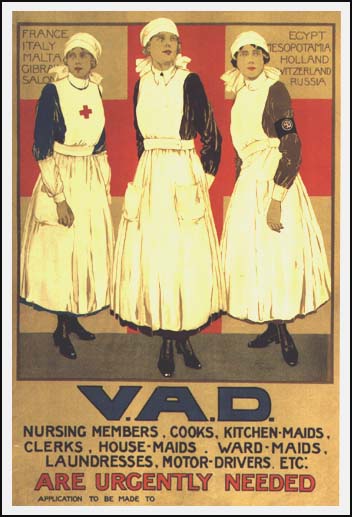
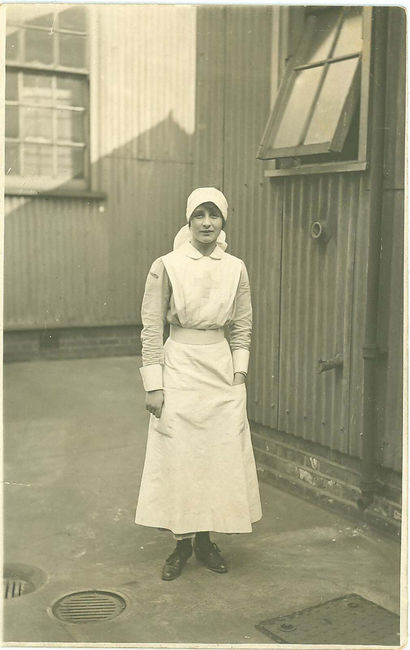
Perhaps the most famous of the VAD nurses was the writer Vera Brittain.
Vera Brittain was born in Newcastle-under-Lyme in 1893 to a wealthy family. She was educated at boarding school and went to Somerville College, Oxford University to study English Literature. In the summer of 1915 after one year at Oxford she delayed her degree to become a VAD nurse, serving throughout the war in London, Malta and France. She is perhaps typical of the VAD profile, well bred, educated and with no practical experiences outside of the home environment and yet she knuckled down and got on with the long hours, in difficult conditions to treat the horrific wounds that are the nature of battle.
During the war she kept a diary and a regular correspondence with her brother Edward Brittain MC, her fiancé Roland Leighton and her two close friends Victor Richardson and Geoffrey Thurlow. In 1916 she wrote to her brother that “If the war spares me it will be my one aim to immortalise in a book the story of us four.” Her fiancé had already been killed by that time. In her correspondence and her memoir ‘Testament of Youth’ she is honest in her description of the hard work her role entailed and the terrible sacrifice that she saw by men and women around her.
She records the experience of near fainting when faced with a gangrenous wound and of the injustice of doctor shortages at a time that the war office was refusing the offer of women doctors joining up.
In the end Vera was the only one of the five to survive. Both the experiences of loss and her own experiences as a nurse left an incredible mark upon her. Her poems reflect her feelings and the realities of conflict just as the male war poets did.
“But still the stars above the camp shine on,
Giving no answer for our sorrow’s ease,
And one more day with the Last Post has gone,
Dying upon the breeze.”
Taken from the ‘Last Post’ from the Verses of a V.A.D. Etaples 1917.
The work that for many defined the loss of a generation ‘A Testament of Youth’ was published in 1933 after many years of trying to grapple with the war years. It is a remarkable memoir of that time, recording the suffering that she and others encountered and continued to live with.
Her first-hand experience of war made her into a lifelong pacifist, a champion for women’s rights and a political campaigner. Although she did marry her relationship was always under the shadow of the loss of her three friends and her brother. When she died in 1970, her daughter Lady Shirley Williams (the former Labour, SDLP and Liberal MP) scattered her ashes on the grave of Vera’s brother wartime grave in Granezza British Cemetery, Italy as had been her wishes – in death she returned to the era that had marked her forever.
References:
Letters from a Lost Generation. edited by Alan Bishop and Mark Bostridge, Abacus, London 1999
Testament Of Youth: An Autobiographical Study of the Years 1900-1925 by Vera Brittain. Virago classic, London 1978